Monthly archives: September, 2025

City Logistics: Moving Forward Together

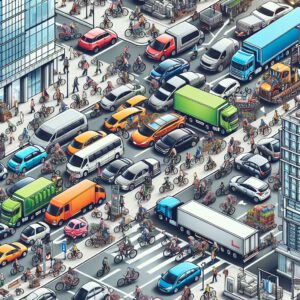
Delivering goods safely and cleanly – and collecting waste efficiently – in our city centers is a significant challenge. This is especially true since the introduction of zero-emission zones on January 1, 2025, while urban populations continue to grow. The Netherlands Environmental Assessment Agency (PBL) predicts that by 2035, the four largest cities will experience …
Transport Refrigeration Units: a significant challenge on the road to zero-emission logistics

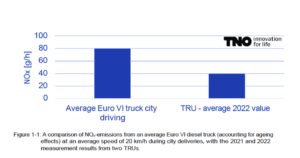
In 2023, the Dutch Ministry of Infrastructure and Water Management launched an action plan to make temperature-controlled transport more sustainable. A key knowledge gap was the contribution of transport refrigeration units (TRUs) to overall emissions. To close this gap, TNO conducted an extensive measurement program on TRU emissions in real-world operations. Monitoring TRUs in practice …

Public Space as Core Infrastructure for Urban Delivery Services

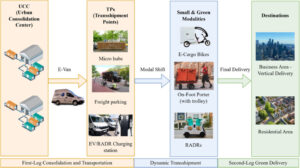
The rapid rise of e-commerce, on-demand services, and shared mobility has transformed public space into a critical logistics and mobility infrastructure. Curbs, sidewalks, and small urban plots—once peripheral in transport policy—are now contested sites for parcel lockers, micro- and mobility hubs, and charging stations. Policy debates and research increasingly frame the curb as a scarce …

Waste Collection in Cities: Can It Be Done Better?

Circular models can be both sustainable and profitable—if developed with the right partners. But is municipal waste collection truly a core competence? Urban waste collection is a complex challenge. In many cities, residents and businesses struggle with persistent litter on the streets. Despite the efforts of frontline staff, stricter rules, and awareness campaigns, waste problems …

Federated Digital Twins for Smart City Logistics

Urban logistics is under mounting pressure. Population density is rising, e-commerce is accelerating, and regulatory requirements are tightening. Traditional logistics systems, with their reliance on static planning, are increasingly inadequate. They struggle to adapt to the dynamic realities of urban environments, leading to inefficiencies, congestion, and environmental challenges. A recent paper by Liu, Pan, and …

Dynamic Freight Management: A New Path for Sustainable Urban Logistics

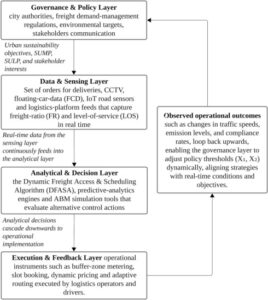
Sustainable management of urban logistics (UL) is becoming increasingly urgent as cities grapple with rising congestion, worsening air quality, and growing e-commerce demand. Traditional freight management models—largely static and inflexible—struggle to cope with dynamic urban environments. A new study by Galkin, Švadlenka, Vrba, and Kijewska (2025) proposes a Dynamic Freight Management (DFM) framework that uses …

Review of A Spatial-Temporal Analysis of Logistics Vehicles

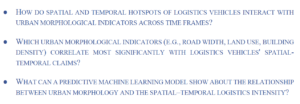
A recent thesis addresses one of the most pressing challenges in contemporary urban planning: how to reconcile the growing intensity of urban logistics activities with broader sustainability and livability goals. It adopts a spatial-temporal perspective on logistics operations, combining spatial analytics, machine learning, and case studies from Dutch cities. Conceptual framing The thesis rightly identifies …

Smarter Kerbside Management Shows Strong Results for London’s High Streets

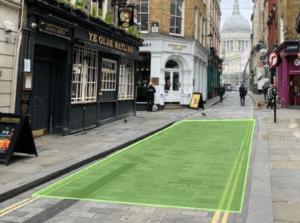
A new report from London’s Cross River Partnership (CRP) highlights how digital kerbside management can transform freight operations and urban air quality. In collaboration with Grid Smarter Cities, CRP piloted a network of eight Virtual Loading Bays (VLBs) across London. Kerbside Management Technology Kerbside Management Technology is designed to dynamically manage urban kerb space, helping …

Behavior-Based Pricing Meets Promised Delivery Times: What Firms and Policymakers Should Know

The rapid growth of information technology enables firms to track consumer purchase histories. This allows them to distinguish between new and returning customers, and to adjust both prices and delivery promises accordingly. A recent study develops a two-period duopoly game-theoretic model to examine how these strategies (behavior-based pricing (BBP) and behavior-based promised delivery times (BBT)) …