Tag «construction logistics»

Building Beyond Linear: How Circular Construction Will Reshape Space, Logistics and Value Chains

The construction sector is entering a strategic inflection point. Climate adaptation, housing demand, sustainability regulation, material scarcity, energy transition, mobility decarbonisation, and spatial constraints are converging. This combination makes one thing clear: linear construction is no longer viable. The Interreg ASSET project examined how a circular built environment can be spatially, logistically, and economically implemented in Europe, …

Antea Local Traffic Monitor: also for analysing urban logistics and construction traffic

Cities are constantly in motion. New housing developments, new and redesigned streets, and growing logistics flows all require innovative solutions to keep the city traffic-safe, liveable, and sustainable. The Local Traffic Monitor, developed by Antea Group together with the municipalities of Rotterdam and The Hague and the Topsector Logistics, offers precisely that: an objective instrument …

Construction: POLIS Calls for Integrated Transport and Sustainability in the EU’s Housing Strategy

As the European Commission prepares its new European Strategy for Housing Construction, POLIS has issued a clear and timely message: Europe cannot solve its housing challenges without integrating transport, sustainability, and regional cooperation into the heart of the strategy. POLIS welcomes the Commission’s ambition to strengthen Europe’s housing sector—not only as a driver of economic …

Why predicting urban construction transport demand is so difficult – And why it still matters

Urban freight models are crucial in managing city logistics, yet they often fall short in construction transport. Unlike regular freight flows driven by economic activity and consumer demand, construction logistics are shaped by a unique mix of project-specific and local contextual factors. Traditional freight models, which rely on high-level economic indicators, struggle to deal with …

France advances circular economy with EPR for construction waste

In France, national and EU-level regulations guide the recycling of construction and demolition materials to foster a circular economy and reduce environmental impact. The Anti-Waste and Circular Economy Law (AGEC Law) was a key milestone introduced in 2020. This law established Extended Producer Responsibility (EPR) for building materials, making producers accountable for the entire lifecycle …

The 2024 Paris Games, sustainable innovation accelerators for city logistics

Paris 2024 Games: 754 competitions and ceremonies, 41 Olympic sites, and 20 Paralympic venues in Paris, involving 10,500 athletes, over 10 million spectators, and 45,000 accredited journalists. Goods: 900,000 pieces of sports equipment, 1.3 million other items, 170,000 pallets, 60,000 luggage, and 14,000 last-mile trips. These figures underscore the immense complexity of organizing such a …

Decision support for improved construction traffic management and planning

Cities continually face the challenge of urban densification, necessitating ongoing construction, renovation, and demolition projects. These activities lead to a substantial influx of heavy goods vehicles (HGVs) into urban areas, yet the specific effects of construction transportation on the urban traffic network remain largely unexplored. This research delves into the spatiotemporal network impacts of construction …

Review: turning a spotlight on governance for sustainable urban construction logistics

Construction logistics is a large share of the urban freight network and a bottleneck for an efficient construction process. Especially in the urban area, professionalization of its management may reduce negative environmental impacts for stakeholders like construction companies, policymakers, and residents. In a new review paper, a two-step methodological approach was pursued to shed light …

Smart vertical transport in construction

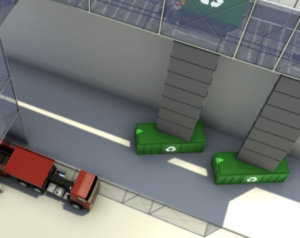
For the construction of high-rise buildings, there is a challenge of organizing large amounts of building materials and resources to and from the construction site and effectively planning for transporting the materials and resources vertically as the building gets taller. The patented Brunkeberg® System adds vertical rails to the exterior facade of a building, providing …