
Amazon Supply Chain Services Opens Its Logistics Network to Third Parties. Are the concerns of UPS, FedEx, and DHL shareholders justified? Amazon has announced Amazon Supply Chain Services (ASCS): a full opening of its logistics network to any business, not just its own marketplace sellers. UPS lost more than 10% in a single day. FedEx nearly 9%. DHL dropped 7%. The market’s message was unambiguous: this feels different.
What Amazon is doing here closely mirrors what it did with Amazon Web Services. AWS started as an internal cloud infrastructure, built to keep its own platform running. Then Amazon decided to rent out that capacity to others. Today, AWS is the world’s largest cloud provider, powering companies like Netflix and Airbnb. Amazon is now following the same route for logistics.
An impressive network
The network is formidable: more than 80,000 trailers, 24,000 vans, and over 100 aircraft. Customers, including Procter & Gamble, 3M, Lands’ End, and American Eagle, are already on board, using ASCS for raw materials transport, inventory management, and parcel delivery. No more juggling five different providers; just one integrated system.
Those services propelled Amazon to become the world’s largest third-party logistics company based on gross logistics revenue in 2025, according to Armstrong & Associates. But the services to date have largely been offered piecemeal, allowing companies to hire Amazon specifically for e-commerce order fulfillment or freight shipping, but not for their full supply chain needs. Amazon has quietly become one of the world’s largest 3PLs. By consolidating its supply chain services under one roof, it now competes head-on with logistics giants like DHL, DSV, and Kuehne + Nagel in a global logistics market worth over $1.3 trillion. For incumbents, this is no longer a rumble on the horizon. Amazon is already at the door, according to experts in WSJ.
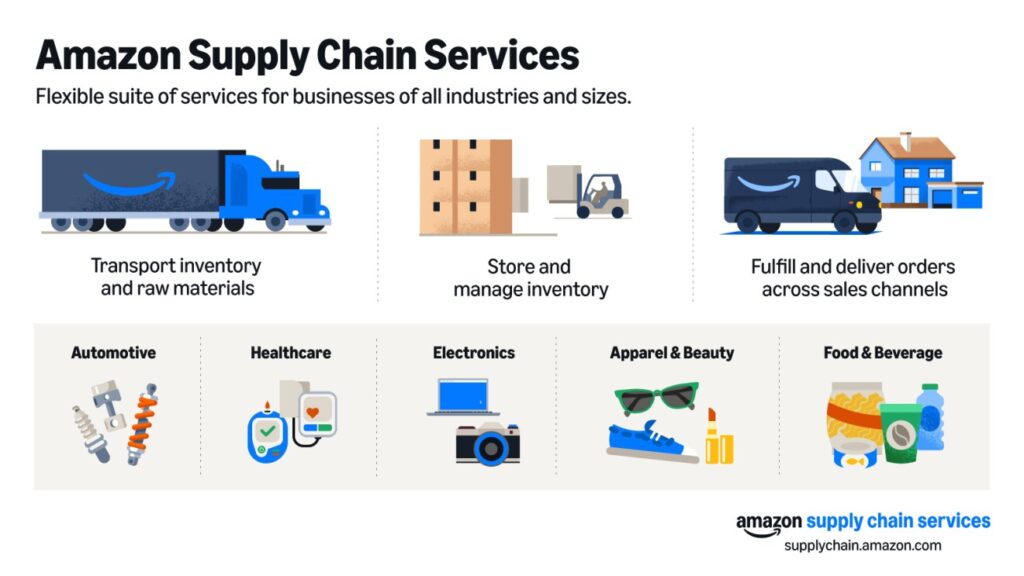
For businesses in logistics and transport, the core question is no longer whether Amazon is entering the market. It already has. The real question is: what does this mean for their position? Companies that compete purely on price or scale face serious headwinds. Amazon has deeper pockets, superior technology, and years of supply chain data. That is not a battle you can win on those terms.
But logistics is about more than infrastructure. It demands sector-specific knowledge, flexibility when things go wrong, human relationships, and local roots. Amazon is building a platform for the masses. Niches, customization, and customer intimacy. Those do not scale easily inside an automated system.

Can Amazon succeed?
Remember how the market reacted when Amazon announced its own pharmacy? Pharmacy stocks collapsed. When Amazon acquired Whole Foods supermarket stocks followed. Both times, the panic proved overblown. Amazon Pharmacy remains a fraction of CVS’s size. In groceries, Amazon has barely made a dent.
The lesson from pharmacy and supermarkets is not that Amazon always fails outside its core domain. The lesson is that established players who use the time to differentiate and specialize prove far more resilient than a panicking stock market suggests. Amazon has money and scale. The competition has expertise, relationships, and agility.
This is going to be a fascinating fight.
Walther Ploos van Amstel
Also read: The parcel market is broken