
Every day, hundreds of sofas, armchairs, and chairs are left out on the streets of Dutch cities. Sometimes properly reported to the municipality, often just abandoned on the pavement. The end of a product that has served its purpose for an average of seven to seventeen years, and that, in most cases, goes straight to the incinerator.
This is not just an environmental issue. It is a logistics issue. And one where urban logistics has barely begun to play a role. But that is about to change, because the Dutch government is preparing legislation that will upend the entire furniture sector.
Ten million tonnes a year, almost all incinerated
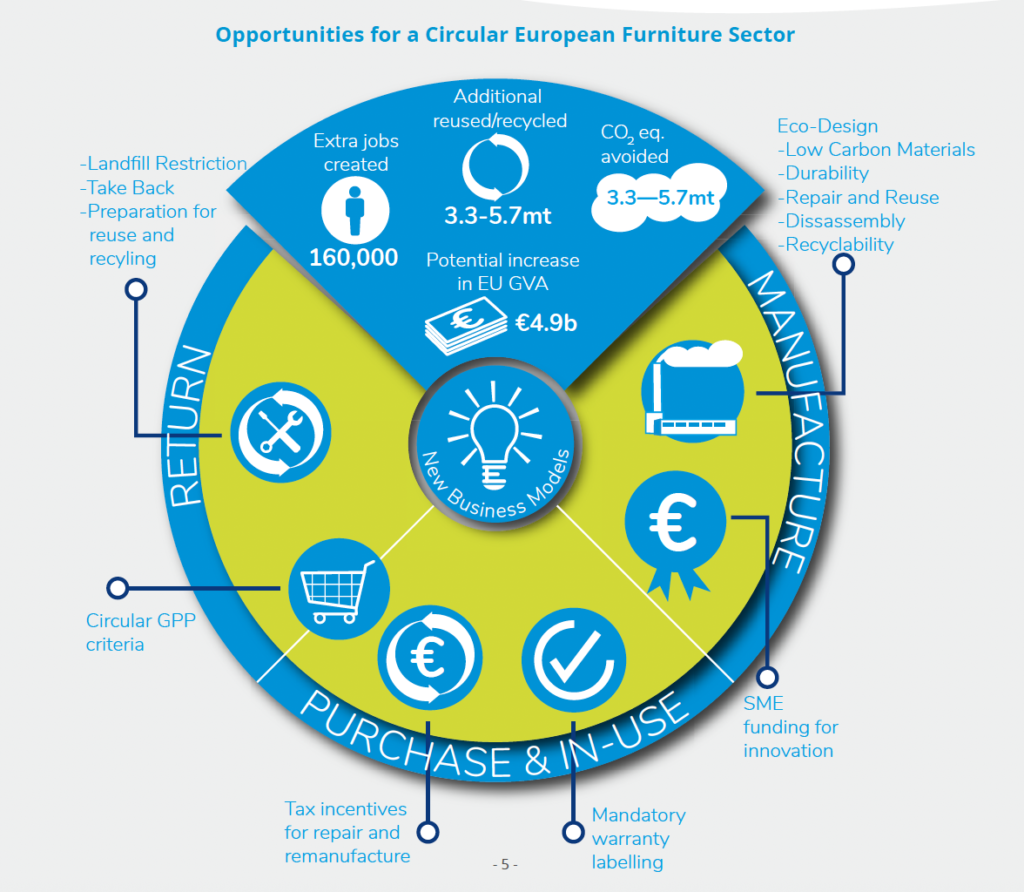
The scale of the problem is striking. Every year, around ten million tonnes of furniture are discarded by businesses and consumers across the EU, according to a widely cited report by Eunomia Research & Consulting for the European Environmental Bureau. The vast majority ends up in landfills or incinerators. Improved reuse and refurbishment could generate 157,000 new jobs and save around six million tonnes of CO2 equivalent — but only if those materials are actually collected and redirected.
In the Netherlands, the picture is no different. A December 2023 policy exploration by Rebel/TAUW, produced in the context of a proposed mandatory producer responsibility scheme for furniture, shows that approximately 846 kilotonnes of furniture waste is incinerated in the Netherlands every year. That is nearly 90% of the total stream. Only 12% is recycled, and preparation for reuse is barely measurable.
The problem is in the first kilometer
In urban distribution, the “last mile” is widely recognized as the most expensive and complex link in the supply chain. With furniture reuse, the reverse is true: the first kilometer is the problem. How does a discarded sofa — still in reasonable condition, potentially suitable for reuse or refurbishment — reach a charity shop, a craft center, or a second-hand marketplace?
Consumers cannot transport their own furniture. Municipal waste collection services compact bulky waste, making reuse impossible before the item has even left the street. And charity shops and reuse centers face chronic shortages of collection capacity and storage space. A Dutch Rebel/TAUW report is direct on this point: furniture is bulky, storage costs are high, and space simply isn’t available at many locations. The result is that charity shops end up sending around 40% of what they take in to incineration anyway — not for lack of will, but because the logistical and spatial infrastructure is inadequate.
A legal obligation is coming
The Dutch government is preparing an Extended Producer Responsibility (EPR) scheme for furniture, due to become mandatory by 2030. Producers will be held financially and organisationally responsible for the end-of-life phase of their products, covering everything from freestanding furniture, such as sofas and beds, to fitted kitchens and bathrooms.
The researchers behind the Rebel/TAUW report do not advocate a separate collection target; instead, they propose a combined target for recycling and preparation for reuse of at least 25%. The reasoning is straightforward: any producer that wants to meet this target will be forced to substantially improve collection infrastructure. The report also floats an old-for-new scheme, under which producers would take back old furniture at the point of delivery of a new piece. That is precisely the kind of model that directly implicates urban logistics operators.
What France shows is possible
The most advanced example of what can be achieved comes from France. Ecomaison — founded in 2011 as Eco-mobilier under a mandatory producer responsibility framework — collected 1.7 million tonnes of end-of-life furniture in 2024, achieving a recovery rate of 97% through reuse, recycling, and energy recovery. The network encompasses 12,000 collection points and 580 partners in the social and solidarity economy. Every French citizen now has a drop-off point within 15 kilometers of their home. That is not a coincidence: it is urban logistics as deliberate policy, made financially viable through producer levies.
The opportunity for urban logistics
This is where a concrete role emerges for urban logistics operators. The reverse flow of used furniture is predictable and, in principle, can be bundled with existing delivery rounds. A furniture delivery driver dropping off a new sofa could take the old one away, provided there is a destination for it and a condition assessment can be completed quickly enough. IKEA is already testing this exact model across multiple markets, with over 430,000 items given a second life through its buyback scheme in 2023 alone.
The forthcoming EPR legislation makes this no longer optional. Producers that must demonstrate by 2030 that at least 25% of their furniture is recycled or prepared for reuse will need a functioning collection chain. That chain runs directly through cities: past homes, municipal waste sites, charity shops, and sorting centers. Urban logistics is the indispensable link connecting these nodes.
The Rebel/TAUW report is candid that reliable data on collection volumes and costs is still largely absent. Better monitoring is a precondition for the EPR scheme to function properly. But the direction is clear. The sofa sitting on the pavement waiting for the rubbish truck is potentially a raw material, a product, or a second-hand purchase. But only if someone picks it up — and only if the infrastructure to make that happen is finally built.
Walther Ploos van Amstel.