Author archives

Research: identifying barriers and enablers for circular economy business models
Circular economy business models (CEBMs) are identified as essential levers in the transition to a circular economy (CE). In recent years, a growing body of research has examined the barriers and enablers to these models; however, the available empirical evidence still needs to be improved while sector-specific assessments are lacking. A recent study aims to enrich the …
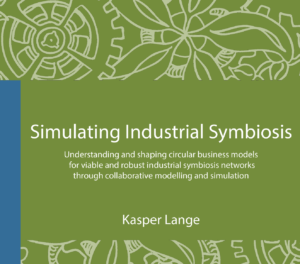
Industrial symbiosis is essential to the circular transition

The European Commission aims for a full circular economy (CE), which will reuse all resources in 2050. Implementing circular urban supply chains is a major economic transformation that can only work if significant coordination problems between the actors involved are solved. This requires, on the one hand, the implementation of efficient urban collection technologies, where process …

Road safety: trucks versus bikes

Over a third of traffic fatalities and over two-thirds of seriously injured traffic in the Netherlands are cyclists. The death rate of cyclists (the number of traffic fatalities per distance traveled) is more than eight times higher than that of motorists but more than three times lower than that of motorized two-wheelers. Almost three-quarters of …

Train and bike: a marriage made in heaven. But don’t forget walking first!

The Guardian reports about the underwater bike garage that should solve Amsterdam Central Station’s bike parking headache by offering space for 7.000 bicycles. The city of Amsterdam facilitates underwater bike parking to return the public space to pedestrians (residents, visitors, commuters). According to the Guardian, the garage results from a 4-year and €60 million project to clear …

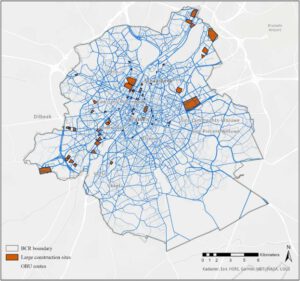
A GPS-based approach to measure the environmental impact of construction-related traffic

Mobilise developed a methodological approach to derive construction-related truck kilometers on city level based on algorithmic and geospatial analyses of GPS data. Results show that large urban construction sites account for 26.4% of total HGV traffic in Brussels. Methodologies used so far make abstraction of traveled vehicle-kilometers (vkm), hence inadequately determining the true environmental impact …

Research: dynamic vehicle routing with random request

Stimulated by the growing demand for logistics services and the advances in information technologies, research interest in the dynamic vehicle routing problem with random requests (DVRPRR) increased over recent decades. The DVRPRR differs from classical vehicle routing in that the customer requests are not fully known in advance but arrive dynamically during the execution of …

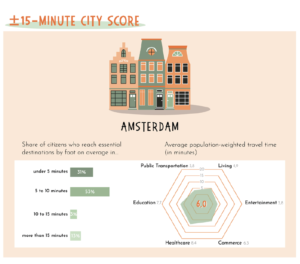
Proximity for all: implementing inclusive 15-Minute City concepts

Researchers from Munich shed new light on the accessibility and inclusion debate in urban mobility. Taking Carlos Moreno’s 15-Minute City concept as a starting point, nurtured by the latest insights from recent experiments, the scientists developed a practitioner’s roadmap highlighting concrete steps to plan, develop and implement the 15-Minute City in a few neighborhoods but …

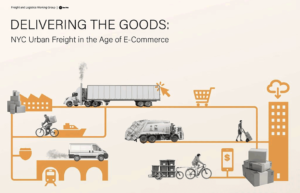
AIANY presents plan for city logistics in NYC

Each year, 365 million tons of freight move through the New York City area. While this flow of goods brings many economic benefits, it also raises complex challenges, especially at the middle-mile and last-mile segments of the delivery supply chain, contributing to traffic congestion, greenhouse gas emissions, public health and safety issues, and the degradation …