
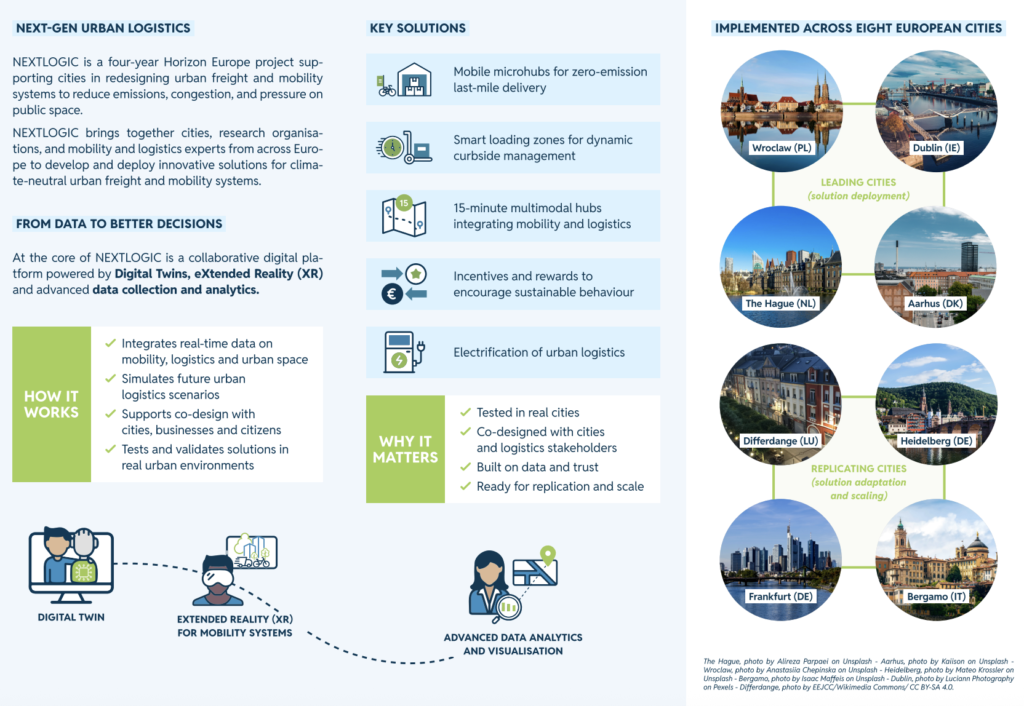
The Horizon Europe project NEXTLOGIC has released its first major deliverable (D1.1), Urban Logistics Challenges, a report that combines a state-of-the-art review with real-world benchmarking and primary data collection across the project’s eight EU Mission Cities: Aarhus, Bergamo, Differdange, Dublin, Frankfurt, Heidelberg, The Hague and Wroclaw.
Coordinated by the University of Luxembourg and led on this deliverable by LAET (France), the report lays the evidence base for the project’s later work on digital twins, co-designed solutions and pilot implementation.
Five solution areas under the microscope
NEXTLOGIC benchmarks five intervention types: integrated mobile microhubs and cargo bikes; smart loading zones (SLZs) and dynamic curbside management; 15-minute multimodal hubs; incentive and reward mechanisms; and electrification of last-mile delivery alongside digital enablers such as digital twins and extended reality.
Some findings stand out. Cargo bikes could replace up to 51% of urban motorized freight trips under the right operational conditions, according to cited ITF research, but their viability depends heavily on locating microhubs within roughly 3 km of delivery areas and on adequate cycling infrastructure. In a curbside management study in Seattle, delivery vehicles spent an average of 2.3 minutes per trip (28% of total trip time) simply cruising for parking, a figure that drops sharply where dedicated loading zones exist.
The report frames 15-minute multimodal hubs as a natural extension of 15-minute city planning, repositioning transport interchanges as multifunctional nodes that combine passenger transfers with parcel lockers, cargo-bike facilities and local consolidation.
What the eight cities have in common, and where they diverge
Despite very different sizes, geographies and policy maturity, all eight cities share the same core obstacles: a persistent lack of granular, real-time freight data; weak enforcement of delivery time windows; pilot projects that become financially unsustainable once subsidies end; fierce competition for scarce curb space; and freight consistently losing out to passenger mobility in political priority.
But each city also carries its own specific friction. Aarhus must work around heritage preservation constraints; Bergamo’s medieval street layout limits vehicle access; Differdange grapples with cross-border freight flows; Dublin’s pro-business culture resists regulation; Frankfurt faces grid congestion that complicates electrification; Heidelberg has limited municipal funding for logistics innovation; The Hague’s legal framework technically permits loading almost anywhere, undermining zone management; and Wroclaw relies heavily on university-led research to drive progress.
The report’s blunt conclusion: one-size-fits-all solutions won’t work, and NEXTLOGIC’s pilots will need to be tailored city by city.
Digital readiness is uneven, and governance matters more than tech
Digital maturity varies widely, from relatively advanced (The Hague, Aarhus, Frankfurt) to lagging (Bergamo, Differdange, Heidelberg) — and even the most advanced cities lack a freight-specific digital twin or real-time data on delivery stops and dwell times.
Perhaps more tellingly, the report finds that formal governance structures matter as much as technology: cities with established Freight Quality Partnerships (Wroclaw, The Hague) or strong university ties (Aarhus, Bergamo, Wroclaw) progress faster than those relying on individual champions or ad-hoc consultation, which the authors describe as “fragile and less effective.”
What this means going forward
The findings directly shape NEXTLOGIC’s next steps: simpler, interoperable dashboards may serve cities better than complex digital twins; business models need co-design alongside technical features, especially for microhubs and smart loading zones; pilots must respect local political and cultural constraints by working through existing stakeholder platforms; and the indicators identified here (compliance rates, illegal-parking reduction, cost per delivery) will feed directly into the project’s impact assessment framework.
The overarching message for city logistics practitioners elsewhere: the value isn’t in a universal blueprint, but in documenting which solutions work under which conditions.
Walther Ploos van Amstel.