
Fleet electrification is usually told as a technology story: replace the diesel van, optimize the route, tick the zero-emission box. Hyunji Chang’s paper in Mobilities tells a different story. Sustainable last-mile delivery is not simply implemented. It is assembled, day by day, by the people who do the work.
Chang studied PostNL’s rollout of light electric freight vehicles (LEFVs) in response to the Dutch zero-emission zones that took effect in January 2025. She interviewed 26 drivers, warehouse process managers and headquarters staff across eight locations. To make sense of what she found, she introduces the concept of the logistical assemblage: the shifting configuration of workers, parcels, vehicles, software, infrastructure and regulation through which freight actually moves.
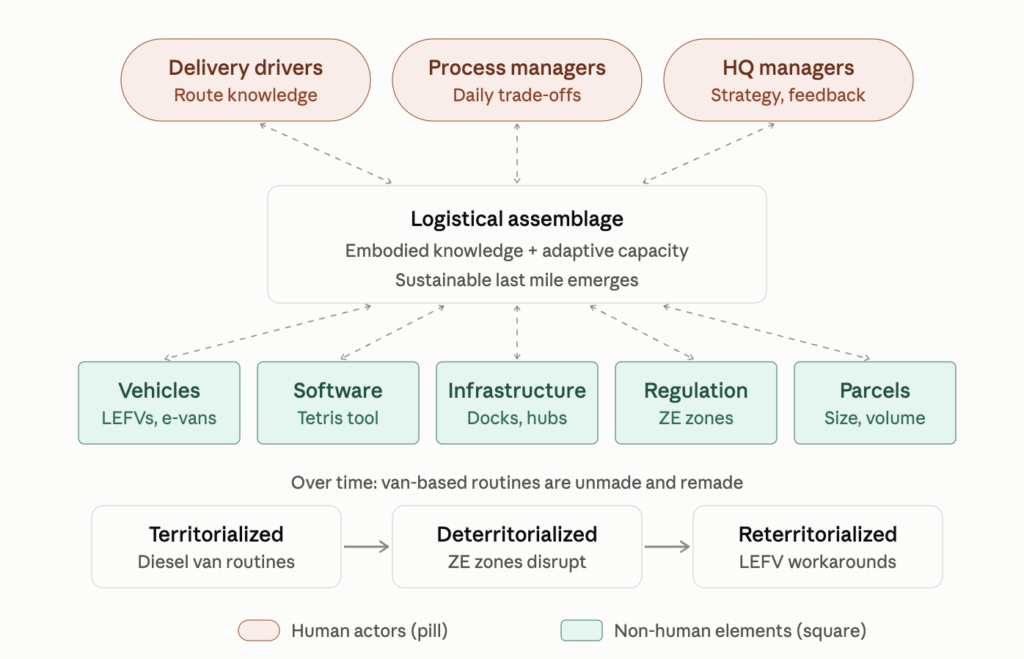
Three findings stand out.
First, LEFVs are not a one-on-one swap for vans. Smaller cabins, limited range, and parcel-size restrictions forced managers to make time-pressured decisions about volumes, rerouting, and staffing, often just hours before routes started. PostNL’s “Tetris tool” for stacking parcels helped, but workers routinely overrode it. Managers underloaded vehicles to be safe. Drivers found hidden spaces for soft pouches. As one software developer put it, drivers make it work “where software stops.”
Second, embodied knowledge is the real engine of efficiency. Knowing who is home when, which neighbor accepts parcels, and where a vehicle can park safely is tacit, route-specific, and hard to transfer to machines. Pre-sorting by others, meant to ease drivers’ workload, instead reduced their autonomy, not least because the tool did not sort parcels in route sequence. Some experienced drivers resisted LEFVs or switched routes to keep their vans. Managers quietly accommodated them, diverging from corporate strategy to keep operations running.
Third, sustainability is quietly redefined along the way. Extra electric vans absorb oversized parcels, and drivers often commute by car to shared LEFVs at warehouses near highways. The result: emissions shift beyond zone boundaries rather than disappear. Yet managers also discovered a different benefit. Lighter loads and doorstep access reduce physical strain, and some deliberately assign older drivers to LEFVs so they reach retirement in good health. Social sustainability entered through the back door.
Why this matters for city logistics
The paper challenges the optimization logic that dominates our field. Policy and corporate strategy assume a single optimal solution; practice shows plural, local assemblages held together by improvisation, relationships and tolerated failure. For cities, this means zero-emission zones reshape work, not just vehicles.
For companies, it means structured feedback loops with drivers are an innovation asset, not a nuisance.
And for AI and automation, it raises a sharp question: which knowledge can be datafied, and which must be supported rather than replaced?
The lesson is simple. Electrification changes the vehicle. People change the system.
Supported by ClaudeAi
Source: Chang, H. (2026). “On the way” to sustainable last-mile: seeing delivery work as logistical assemblage. Mobilities, 1–16. https://doi.org/10.1080/17450101.2026.2736640
Photo: PostNL