
A master’s thesis from Delft University of Technology (TU Delft) offers a useful corrective for fleet managers who view electric truck adoption primarily as a procurement decision: pick a Battery Electric Truck (BET), sign the purchase order, and that’s it. Boris Leferink’s research, “The Real Decisions Behind Electric Truck Procurement” (supervised by Prof. Lóri Tavasszy, with input from an OEM, a freight forwarder, consultants, and several fleet operators), argues that this framing is precisely what causes electrification programs to stall.
The purchasing decision, the study finds, triggers a web of interdependent strategic, tactical, and operational choices that must be aligned before a truck can be deployed successfully. Most of the friction fleet operators experience stems from treating those choices as afterthoughts.
The scale of the challenge
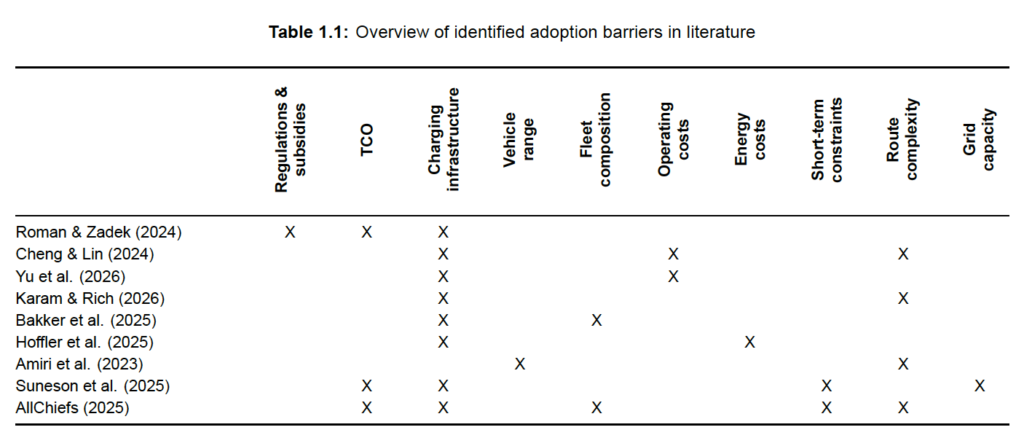
The context is familiar to anyone in road freight: Heavy-Duty Vehicles (HDVs) make up only about 2% of vehicles on European roads but generate roughly a quarter of road transport CO2 emissions. The EU’s 2050 climate-neutrality target and 2030 CO2 regulations for new HDVs put real pressure on operators, yet battery-electric trucks still account for only about 0.3% of the EU truck fleet (some 18,000 vehicles) and just 2.3% of new registrations in 2024. Costs are increasingly competitive (BETs can already beat diesel on Total Cost of Ownership in some use cases, and cut lifecycle emissions by 75–85%), so cost alone doesn’t explain the slow uptake. Leferink’s thesis sets out to explain what does.
Why “short-haul, line-haul, long-haul” isn’t granular enough
One of the study’s more practically useful contributions is the rejection of the usual shorthand for describing fleet suitability. Instead of three broad transport profiles, the thesis identifies seven operational dimensions that actually determine whether a route or duty cycle is BET-ready: route predictability, return-to-base frequency, charging control, daily distance, payload sensitivity, planning flexibility, and utilization intensity. Two operations both labeled “short-haul” can look completely different once you break them down this way. One might have high charging control and predictable routes; another might have unpredictable customer scheduling that makes overnight depot charging unreliable. For a fleet manager scoping a first electrification pilot, this is the more honest diagnostic tool: rather than asking “are we short-haul or long-haul,” ask where each of these seven dimensions actually sits for a specific route or customer segment.
The framework: three decision levels, not one
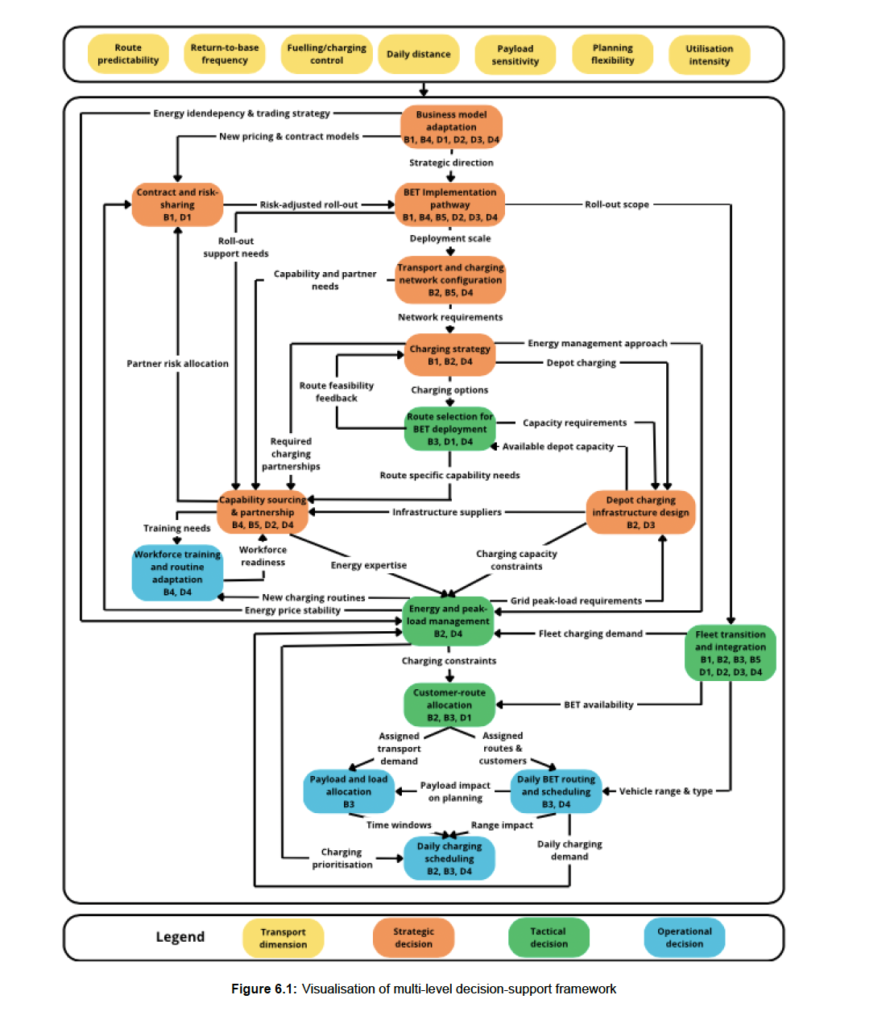
The thesis’s central output is a multi-level decision-support framework, built from a literature review, conceptual modeling, and two rounds of semi-structured interviews with fleet operators, consultants, an OEM, and a freight forwarder (coded deductively and inductively around barriers, drivers, decisions, and transport dimensions). It organizes the decisions fleet operators actually face into three tiers:
Strategic level — decisions about how the organization prepares for electrification before any truck hits the road:
- Business model adaptation
- Contracting and risk-sharing
- BET implementation pathway
- Capability sourcing and partnerships
- Depot charging infrastructure design
- Charging strategy
- Transport and charging network configuration
Tactical level — how strategic choices get translated into deployment:
- Route selection for BET deployment
- Customer-route allocation
- Fleet transition and integration (mixing electric and diesel)
- Energy and peak-load management
Operational level — day-to-day execution:
- Daily routing and scheduling
- Daily charging scheduling
- Payload and load allocation
- Workforce training and routine adaptation
The framework isn’t meant as a one-way checklist, though. A key finding is that the operational level also acts as a feedback loop: recurring problems on the ground (such as trucks not following their routes, chronic charging conflicts, payload shortfalls) are often symptoms of decisions made incorrectly at higher levels, strategic or tactical. If drivers keep running out of range or charging windows keep clashing, the fix usually isn’t operational fine-tuning; it’s revisiting the charging strategy or route-selection decisions that were made months earlier.
Barriers and drivers aren’t just background noise
The thesis also maps five barrier clusters (financial constraints; charging and energy constraints; technological and operational mismatch; organizational readiness gaps; and transition management uncertainty) and four driver clusters (customer market pull; strategic and business motivation; fiscal and regulatory incentives; and growing transition readiness).
The useful insight for managers isn’t the taxonomy itself but the claim that these factors don’t sit outside the decision-making process. They actively shape which decisions are feasible and the order in which they need to be made.
Grid capacity, for instance, doesn’t just constrain a company’s ambitions in the abstract; it directly constrains depot charging infrastructure design, energy management choices, and daily charging schedules, in that order. Similarly, customer demand for lower-emission delivery can be strong enough to justify early deployment on a specific route even before the broader business case is fully proven elsewhere in the fleet.
What this means for transport managers
For a fleet manager weighing electrification, the thesis suggests a few concrete takeaways:
- Don’t start with “which truck”, but start with which routes score well across all seven operational dimensions, particularly charging control and return-to-base frequency, since these tend to be the binding constraints in practice.
- Treat charging infrastructure and energy management as strategic decisions on par with the vehicle purchase itself, not as a downstream logistics detail to be sorted out later.
- Expect early operational hiccups to be diagnostic. If a pilot route is underperforming, look upstream before concluding the technology doesn’t work. The more likely culprit is a strategic or tactical decision (charging strategy, route selection, customer allocation) that needs revisiting.
- Use the framework to build a phased, context-specific rollout (starting with routes that combine high predictability, frequent depot returns, and strong charging control) rather than attempting a fleet-wide switch.
A caveat worth noting
The author is upfront about the study’s limits: it’s qualitative and exploratory, based on a relatively small set of expert interviews, and the framework has been refined through discussion rather than tested in a live procurement process. So this is best read as a structuring tool for organizing electrification thinking, like a checklist of the right questions and their sequencing, rather than a validated, quantitative decision model.
Leferink flags follow-up work using methods like DEMATEL to map decision interdependencies more rigorously, alongside integration with tools fleet managers already use, such as TCO analysis, route optimization software, and grid capacity assessments.
The bottom line for practitioners: the thesis’s most quotable line is also its most useful one: the hardest part of electrification is not buying the truck but managing the connected decisions around it. For transport managers under pressure to show progress on electrification, that reframing is arguably more valuable than any single number in the report.
Supported by ClaudeAI