
A new systematic literature review in Transport Reviews by Oliver Olmedo, Otgondulam Boldbaatar, Carla Tejada, Travis Fried, Paul Buijs, Sarah Dennis-Bauer and Anne Goodchild asks a deceptively simple question: when urban freight scholars talk about “stakeholders,” who exactly do they mean, and who gets left out?
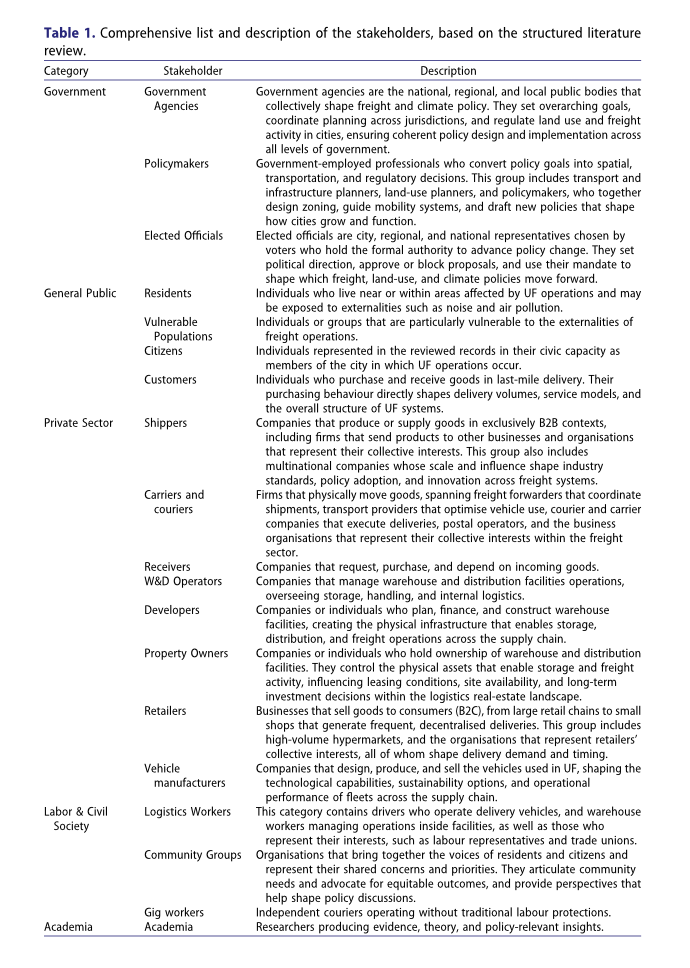
The team screened 6,419 articles, narrowing them to 54 studies published between 2015 and 2025, using a PRISMA-based systematic review process. Coding these records identified 19 distinct stakeholder types, grouped into five categories: government, private sector, general public, labor & civil society, and academia.
The headline finding: an uneven spotlight
Two groups dominate the literature. The private sector was the most frequently represented category: 53 of 54 studies mentioned at least one private-sector actor, with carriers and couriers appearing most often (in 50 records) and shippers close behind (39). Government came second, appearing in 51 of 54 studies, with policymakers mentioned in 39 records.
By contrast, the groups who often bear freight’s external costs are far less visible. Vulnerable populations appeared in just 9 of 54 records, elected officials in only 8, and gig workers in a mere 6. The general public as a whole (residents, citizens, customers, vulnerable populations) featured in 42 of 54 studies, but the authors note these groups are usually framed as passive recipients of policy outcomes rather than active participants in shaping them. Labor and civil society combined appeared in only 20 of 54 records.
The authors are careful not to over-read this: company-focused regulation (emissions rules, delivery-window restrictions) can still deliver distributive equity benefits even when affected residents aren’t explicitly named. But they argue the pattern signals a “recognitional gap”. When affected populations remain implicit in the research, it stays unclear whose burdens and participation are actually being accounted for in policy design.
How stakeholders are shown interacting
The review also mapped interaction patterns. Government is consistently portrayed as setting the regulatory conditions (zoning, low-emission zones, truck routes) within which private-sector actors operate. Cross-category interactions are dominated by this government–private-sector axis, with comparatively little documented on how communities or logistics workers engage directly with either group.
Five engagement models, all with limits
The paper catalogs five frameworks for engaging stakeholders in UF governance: public consultation (often through Sustainable Urban Logistics Plans), freight partnerships, public-private partnerships, living labs, and citizen-led participatory analysis (including community benefit agreements).
None is without flaws. Public consultation and freight partnerships tend to stay purely advisory with no binding authority; PPPs risk favoring large incumbents without careful regulation; living labs need sustained institutional backing to outlast the pilot stage; and citizen-led approaches, while offering the most direct voice to affected communities, are constrained by cost, technical capacity, and data access, often hitting exactly the communities most burdened by freight the hardest.
Why this matters for practitioners
For city logistics professionals and policymakers, the takeaway is less about the presence of stakeholder engagement and more about its composition. The field has made real progress cataloging who’s involved in freight decisions. But the consistent underrepresentation of vulnerable populations, elected officials, and gig workers in the research itself suggests these groups may also be structurally underrepresented at the actual planning table.
The authors offer their 19-stakeholder taxonomy as a practical tool that future studies, and by extension, city logistics practitioners can use to make stakeholder identification more transparent and comparable across projects.
Walther Ploos van Amstel.