Category «Policies»

City logistics innovations: how do we value space?

Genuine innovations in city logistics are about sharing. Sharing capacities, vehicles, data, energy, and people. That should start happening in zero-emission city hubs, local neighborhood hubs, and with waterborne transport. Simple, right? But, those innovations often stumble over the distribution of joys and burdens. The public-private revenue models behind them are not obvious (and profitable). …
What should be in every local city logistics plan?

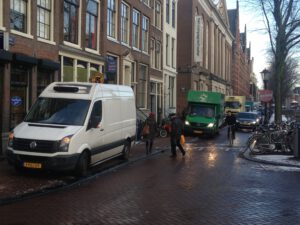
Local authorities have five roles in city logistics: regulate and enforce, facilitate, stimulate, coordinate, and experiment. What eight elements should be in every city logistics plan? Those plans should provide clear guidance for companies in, for example, construction, facilities, parcel, service logistics, and circular flows; what is in store for them? What problems do you …

Zero-emission zones: a guide for cities

Though less than 4% of vehicles on the road are trucks, it is estimated that they are responsible for 27% of road transport’s CO2 emissions. As urbanization grows, absolute population numbers and population density continue to rise in cities. Consequently, urban commercial transport is also increasing, exacerbating congestion and harmful emissions. Action is needed to …

Net zero in 2050: how will transport companies survive?

The logistics sector must be net zero by 2050. But all measures proposed will create an uneven playing field with selective access to logistics capabilities, people, money, data, and energy. So how will transport companies survive? I was asked to lecture on sustainability for a group of CEOs from European transport companies. I hyperventilated. What …

Geofencing for future mobility management

ITS play a growing role in the mobility ecosystem. Cars, public transport, freight, Mobility-as-a-Service, and people and goods are increasingly connected within a collaborative ecosystem with lightning-fast information exchange. This allows us to tackle fundamental challenges in our built environment, such as traffic congestion, noise, pollutant emissions, etc., from a previously unthinkable perspective: dynamically. Geo-fencing …

CCD: trends on Circular Economy in European Cities

European cities face unprecedented challenges, from climate change to biodiversity loss, growing economic instability, and global chain disruptions. The circular economy is increasingly recognized as an excellent opportunity to tackle these challenges, unlocking wide-ranging benefits that help cities thrive and become more liveable and resilient. This is precisely why the Circular Cities Declaration (CCD) has …

ITDP reporting about the opportunities of Low Emission Zones

Low emission zones (LEZs) are essential for cities regulating urban freight. Though low-emission zones have been primarily implemented as an air quality improvement strategy, they have the potential to catalyze a faster transition to electric vehicles and encourage more compact development that facilitates walking, cycling, and using public transportation. Momentum around low-emission zones is growing. …

EU White Paper: zero-emission urban logistics in major city centers by 2030

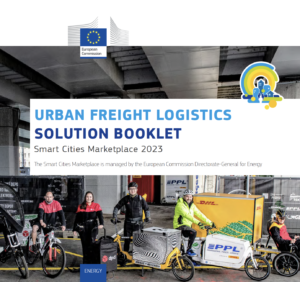
The overall goal of urban freight logistics is to provide better and more customized last-time logistic services for citizens, fostering local economic development through local logistics businesses while reducing the negative impact the delivery of goods has on our urban environment. The European Commission shows a clear interest in sustainable solutions for urban freight logistics, …

New EU plans for less CO2 in road transport toward 2040

the European Commission has proposed ambitious new CO2 emissions targets for new heavy-duty vehicles (HDVs) from 2030 onwards. These targets will help to reduce CO2 emissions in the transport sector. Trucks, city buses, and long-distance buses are responsible for over 6% of total EU greenhouse gas (GHG) emissions and more than 25% of GHG emissions …