Category «Research»

Economic profitability of last-mile food delivery services: Lessons from Barcelona

Incorporating ICT into restaurants has altered the customer-restaurant relationship, especially with customers who prefer to order remotely. In 2019, the online food delivery sector surpassed, for the first time, the barrier of 100 trillion US dollars worldwide, maintaining a sharp upward trend. During the last few years, the number of digital platforms offering allegedly environmentally …

Providing curb availability information to delivery drivers reduces cruising for parking

Delivery vehicle drivers are experiencing increasing challenges in finding available curb space to park in urban areas, increasing cruising instances for parking, and parking in unauthorized spaces. Policies traditionally used to reduce cruising for parking for passenger vehicles, such as parking fees and congestion pricing, are not effective at changing delivery drivers’ travel and parking …

H2020 opportunity: Zero-emission e-commerce and freight delivery and return choices

In May 2023, new H2020 research opportunities are open for zero-emission e-commerce and freight delivery and return choices by retailers, consumers, and local authorities. The total indicative budget for the topic is euro 6 million. Projects are expected to contribute to all of the following outcomes: Better understanding of customers’ willingness and motivations to choose …

How can we boost out-of-home deliveries?

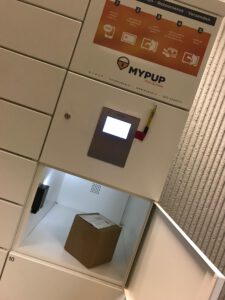
How can we boost out-of-home deliveries? This could be a promising question for those who still believe out-of-home deliveries (click-and-collect) are more sustainable. The ‘last mile’ of delivery is the journey from the depot to our front door. Most last-mile journeys are taken by delivery vans, meaning each delivery contributes to air pollution and congestion. …

Explaining the growth in light electric freight vehicles

Van Duin, Ploos van Amstel and Quak (2022) wrote a chapter in Innovations in Transport explaining the growth in light electric freight vehicles. Literature on ex-post analysis based on real cases with LEFV usage is limited. The application of the Technological Innovation System (TIS) framework can provide insight into the cumulative systematic change toward more …

Joint modeling of arrivals and parking durations for freight loading zones for city logistics

Truck parking, especially curb space management in cities is a key challenge faced by urban freight policy makers and transportation planners. A new paper analyzes truck parking patterns in urban freight loading zones by jointly modeling the vehicle arrival rates and the parking durations. Three models were explored: Count data (Negative Binomial) for vehicle arrivals. Survival …

Delivery shame? No: delivery pride!

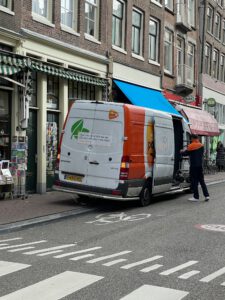
Delivery shame? Delivery pride! Anyone concerned about the environment will order online from now on. This is two to three times less harmful to the environment than going to the store yourself. Reports on the environmental impact of e-commerce are based on solid research. Researchers agree that there is no reason for concern from a …

Autonomous delivery robots: not on the sidewalk, please

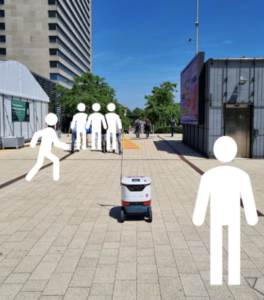
Unlike autonomous car applications, the operational area of urban service autonomous robots like autonomous delivery robots (ADRs) is not clearly defined. Moreover, assessing the feasibility of various operating scenarios is difficult due to large variations in the different robot designs, specific local infrastructure, and regulations. A new paper presents a prototype evaluation methodology based on …

The smaller, the better. Nano-hubs for cargo bike logistics

The expanding freight traffic in the courier, express, and parcel services (CEP) sector is increasingly posing major challenges to urban agglomerations. The main driver for this development is the dynamic growth of e-commerce, as it causes a change in consumer behavior towards an on-demand economy and continuous growth in the volume of shipments in the …

‘Proximity logistics’: the development of logistics facilities in dense, mixed-use urban areas

The maturation of online consumption and the amplification of cities’ initiatives in response to local and global environmental challenges has placed goods transport, an essential but impactful activity, at the forefront of urban stakeholders’ scrutiny. High-performance and low-impact supply chains benefit from the presence of logistics facilities near goods’ destinations. The development of logistics facilities …