Tag «loading and unloading zones»

When parking, not traffic, is the real bottleneck in last-mile delivery
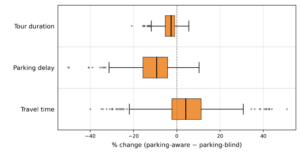
A study in Transportation Research Part E quantifies something every delivery driver already knows: finding a place to park is often harder than finding a route. Giacomo Dalla Chiara and colleagues (University of Washington, University of Groningen) analyzed GPS data from a beverage distributor’s delivery operations in downtown Seattle (472 manifests, over 2,400 trips) to …

Managing the curb: why commercial loading zones deserve a central place in city logistics

Urban freight is competing for an increasingly scarce resource: curb space. The growth of e-commerce, grocery deliveries, on-demand services and ride-hailing has intensified pressure on city streets, while many cities continue to redesign public space primarily for pedestrians, cyclists and public transport. The result is a growing mismatch between freight demand and curb availability, leading …

Smarter Planning for Loading Docks in New Developments

A newly completed project by Transport for NSW, the University of Melbourne, and iMOVE has developed a robust and user-friendly model to help city planners, developers, and transport authorities better assess loading dock needs in new buildings. The report is now available for download. As cities focus more on livability and placemaking, space for freight …

Understanding delivery drivers’ parking preferences in city logistics

Parking for loading and unloading in urban areas is minimal, requiring shared use among various users. Despite its importance, delivery drivers’ attitudes and preferences regarding parking in city environments have not been extensively studied. A recent paper addresses this gap by analyzing survey data from delivery drivers in the northeastern United States. Using stated preference …

Effects of freight curbside management on sustainable cities

Managing freight activities at curbsides has become a contentious issue as various stakeholders compete to access public urban space. While previous research has proposed solutions to alleviate conflicts arising from freight-related space use, there remains a need for a deeper understanding of how these interventions contribute to cities’ sustainable development goals. A new study presents …

Smart loading zones: a data analytics approach for loading zones network design

Urban public space commonly accommodates freight delivery operations through on-street (un)loading zones (LZ). Given the scarcity of public space and its demand by various users, city authorities face the challenge of effectively managing LZ by understanding freight curbside needs and utilization. Despite the popularity of technological solutions and enforcement practices among policymakers to capture curbside …

A planning tool for improving the provision of loading docks

For freight and service vehicles entering a city, parking plays a crucial role in providing access to serve customers. This typically occurs on the street in designated parking spaces or in modern buildings in off-street facilities. Given the evolving priorities in urban planning and the consequent reduction in on-street loading zone availability, this paper delves …

Providing curb availability information to delivery drivers reduces cruising for parking

Delivery vehicle drivers are experiencing increasing challenges in finding available curb space to park in urban areas, increasing cruising instances for parking, and parking in unauthorized spaces. Policies traditionally used to reduce cruising for parking for passenger vehicles, such as parking fees and congestion pricing, are not effective at changing delivery drivers’ travel and parking …

Joint modeling of arrivals and parking durations for freight loading zones for city logistics

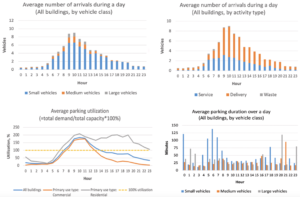
Truck parking, especially curb space management in cities is a key challenge faced by urban freight policy makers and transportation planners. A new paper analyzes truck parking patterns in urban freight loading zones by jointly modeling the vehicle arrival rates and the parking durations. Three models were explored: Count data (Negative Binomial) for vehicle arrivals. Survival …

➤