Tag «urban mobility»

Water: the forgotten link in urban public transport?

Cities like Amsterdam, Utrecht, London and Paris were built on water, yet largely stopped using it as a means of transport in the twentieth century. With urban densification, climate adaptation and zero-emission targets converging, water deserves a mature place in the urban mobility mix; not as a tourist sideshow, but as a functional, affordable and …


Rethinking passenger-vehicle coordination in urban mobility

In the age of smart urban mobility and AI-driven ride-hailing platforms, it’s easy to assume that more technology means better performance. But new research reveals a surprising insight: in some urban environments, old-fashioned, low-tech transport modes can outperform their high-tech counterparts—simply because they’re easier to coordinate. At the heart of this finding is a fresh …

New report estimates €1.5 trillion investment needed for sustainable mobility by 2050 in Europe

EIT Urban Mobility has unveiled its latest study, “Costs and Benefits of the Urban Mobility Transition.” This comprehensive report examines how European cities can navigate the complex path to meet the EU Green Deal’s transport sector goals for 2030 and 2050, assessing various mobility strategies’ financial and societal impacts. Transition scenarios An update to the …

A review of city-wide 30 km/h speed limit benefits in Europe

European cities increasingly implement 30 km/h speed limits across street networks. A new paper aimed to evaluate the effectiveness of such speed limits in Europe. Quantitative methods and qualitative assessments were used to condense research findings. The study examined the impact of city-wide 30 km/h speed limits on safety, the environment, energy consumption, traffic, livability, …

What should urban mobility workers know better?

A new report elaborates on the CIVITAS European Urban Mobility Labour Market Research about which skills and knowledge are needed by professionals working at and for urban planning authorities. The report showcases an analysis of the current status quo, trends, and developments of the urban mobility labor market, needs for knowledge and skills, the urban …

Next phase for Amsterdam Roboat to boost future-proof urban mobility as a spin-off company

After six years of research by the Massachusetts Institute of Technology (MIT) and Amsterdam Institute for Advanced Metropolitan Solutions (AMS Institute), Roboat has officially launched independently. The project, which focused on developing autonomous navigation technology for boats for urban and inland waterways, has now transitioned into a spin-off company that will scale up the technology …

McKinsey: will the coming mobility revolution make urban traffic better?

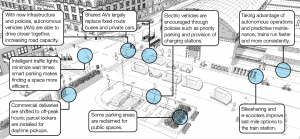
Despite governments’ best efforts, traffic is getting worse in many cities, and urban mobility has become increasingly complex. Congestion carries health consequences, in the form of accidents and air pollution. Demographic trends will accentuate today’s strains, which aren’t solely about the movement of people. E-commerce is also growing fast, adding to the demand for urban commercial …

➤