
City logistics research has a problem. Not a shortage of data, not a lack of clever algorithms, and not an absence of ambitious pilots. The problem is simpler and more stubborn: too much knowledge stays on the shelf. Reports get written, conferences get filled, and meanwhile, the delivery van is still double-parked on the bike lane.
That needs to change. And the Impact Plan approach (developed by NWO, the Dutch Research Council) offers a compelling way forward.
What Is the Impact Plan Approach?
The aim of the Impact Plan approach is to purposefully increase the chance of societal impact of research. Its core is an integrated strategy that promotes Productive Interactions through a Theory of Change and Impact Pathways.
In plain language: it is a structured way of asking, right from the start of a research project, who needs to change their behavior for this research to matter — and how do we get there?
A Theory of Change is a schematic presentation that shows how a program or project can bring about desired changes for a target group in a specific context. It makes underlying assumptions explicit and provides insight into how formulated activities can contribute to the ultimate goal.
The path from outputs (insights from research) to outcomes (changes in behavior based on those insights) to impact (larger changes in society) is outlined in several Impact Pathways. These provide a better understanding of how change can occur and a stronger grasp of planning, monitoring, and evaluation.
Why City Logistics Research Needs This
City logistics sits at the intersection of urban planning, business operations, environmental policy, consumer behavior, and technology. It is, by definition, a domain of multiple actors with competing interests. Municipalities want clean and quiet streets. Carriers want efficient routes and fair rules. Retailers want a reliable supply. Residents want liveability. Researchers want rigor.
Traditional research often serves one of these audiences well, and the others barely at all. The Impact Plan approach forces a different conversation from day one: who are our stakeholders, what do we want them to do differently, and what will it actually take to get there?
Productive Interactions as the Engine of Change
The concept of Productive Interactions is especially powerful in the context of city logistics. These are exchanges between researchers and other stakeholders in which knowledge is generated and valued that is both scientifically robust and societally relevant; through co-design, conducting research together, or discussing results interactively.
Imagine a research project on zero-emission urban consolidation centers. Rather than handing municipalities a finished model, the Impact Plan approach would have researchers co-designing the research questions with logistics service providers, city planners, and local business associations from the outset. Carriers share operational realities that no dataset captures. Planners reveal political constraints that no algorithm anticipates. Retailers articulate service requirements that no academic paper has yet asked about.
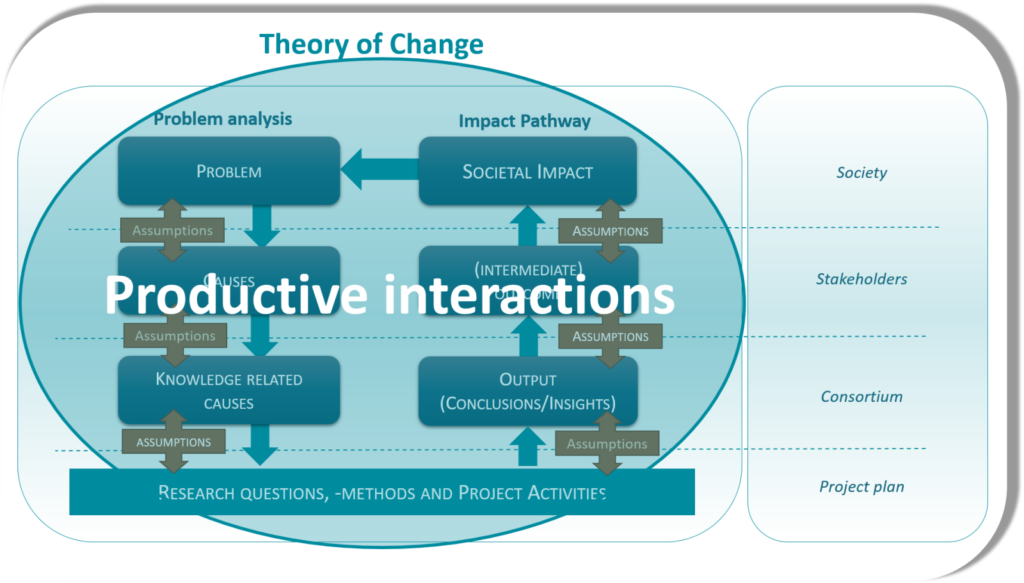
The result is research that is not just smarter; it is trusted, adopted, and acted upon.
A Theory of Change for the Last Mile
What might this look like in practice? A research team studying e-cargo bike logistics in Dutch city centers could map their Theory of Change like this: their research outputs (operational data, cost models, emissions analyses) would feed into outcomes such as municipal procurement criteria and carrier investment decisions, ultimately contributing to the impact of measurably fewer diesel vans in the urban core by 2030.
Each assumption in that chain gets named and tested. Will municipalities actually revise their procurement criteria? What would stop them? Who else needs to act? These questions sharpen the research design before a single survey is sent.
The Invitation
City logistics is not short of ambition. What it needs is research that is designed — from its very first workshop — to land. The Impact Plan approach offers exactly that discipline: a structured, honest, and collaborative way of connecting scientific rigor to the streets, docks, and loading bays where cities actually run.
The question is no longer, “What do we want to know?“ It is what needs to change, who can change it, and how does our research help them get there? That is a research agenda worth funding.
Walther Ploos van Amstel.