Category «Research»

The Price of Green: How Surcharges (and Smart Messaging) Can Shift Consumer Delivery Choices

Summary of: Kokkinou, A., Quak, H. & Mitas, O. (2026). “Leveraging fairness to nudge consumers towards more sustainable last mile delivery options.” Transportation Research Interdisciplinary Perspectives, 37, 101956. Every time a consumer clicks “next-day delivery,” they make a choice with real urban consequences; more vans, more congestion, more emissions. Getting consumers to voluntarily choose slower, …

Which Last-Mile Innovations Actually Work? New Delphi Study Ranks 13 Solutions for Urban and Rural Areas

As e-commerce volumes grow and decarbonisation pressure intensifies, the question of which last-mile logistics innovations are worth investing in has never been more pressing. A new peer-reviewed study published in the European Transport Research Review offers some of the most structured expert guidance to date — and the findings may surprise both logistics operators and …

City Logistics and Urban Hubs: No Silver Bullet, but Context Matters

Urban freight transport is increasingly at the center of policy and research debates, driven by rising e-commerce demand, urban densification, and the introduction of zero-emission zones across European cities. A recent analysis by the Dutch Kennisinstituut voor Mobiliteitsbeleid (KiM) provides a systematic and evidence-based perspective on one of the most discussed solutions: urban consolidation centers, …

Cooperation or competition? What parcel lockers teach us about city logistics

E-commerce has changed urban logistics fundamentally. Orders are smaller, destinations are more dispersed, and customers expect fast delivery within narrow time windows. The result is familiar in many cities: more vans on the streets, lower vehicle utilisation, and increasing pressure on urban space. In his recent PhD research, Fabio Mercurio explores how delivery companies respond …

Circular Construction Requires Smarter Logistics

The Dutch construction sector purchases nearly 49 million tonnes of materials annually (excluding soil, sand, and clay), while only about 20 million tonnes become available from demolition and renovation. Demand is therefore roughly 2.5 times higher than the sector’s own secondary supply. This structural gap lies at the heart of the circular construction challenge. Recent …

Integrating Zero-Emission Vehicles and Micro-Hubs in Urban Freight Logistics

A comparative routing-based analysis shows that battery electric vehicles are most efficient for short and medium urban routes, while hydrogen fuel cell vehicles are better suited for longer inter-urban missions. Decoupled logistics models using micro-hubs and cargo bikes reduce curbside occupation by up to 80%, significantly improving public-space efficiency. Sustainable urban freight transitions require combining …

Assessing the Sustainability of UCCs: a Context-Sensitive Framework

Urban freight transport is under increasing pressure. Rapid urbanization, the growth of e-commerce, and stricter climate targets are forcing cities to rethink how last-mile logistics (LML) is organized. Against this backdrop, Sobrino et al. (2026) propose a novel sustainability impact assessment framework and apply it to an Urban Consolidation Center (UCC) in Madrid’s city center. …

Cargo Bikes: Why Long-Term Trials Matter for Fleet Transformation

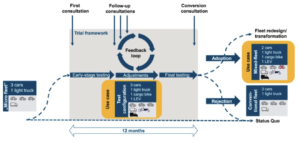
Cargo bikes and light electric vehicles (LEVs) are widely promoted as sustainable alternatives for commercial transport. Yet despite supportive policies, technological improvements, and rising environmental pressure, adoption remains limited. The core barrier is not purely technical or economic. It is organizational. A recent study by researchers at the German Aerospace Center introduces a 12-month long-term …