Category «Research»

Modeling the dynamics of freight transport decarbonization: a review and research agenda

The article “Modeling the dynamics of freight transport decarbonization: A review and research agenda” (Tavasszy et al., 2026) examines how existing freight transport models largely fail to address the dynamic processes required to achieve climate neutrality. The core question is not whether decarbonization is technically possible, but how long it will take and how reliably …


Missing the forest for the trees: what road freight decarbonisation research overlooks

Freight transport accounts for a substantial share of global greenhouse-gas emissions and is expected to grow strongly in the coming decades. Against this backdrop, a new paper examines how academic research addresses the decarbonisation of road freight and urban logistics. The results reveal a rapidly expanding field that remains surprisingly fragmented and heavily technology-centred. Rapid …

Rerouting the Last Mile: How Workers Shape Sustainable Urban Logistics

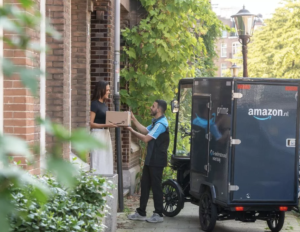
The last mile is undergoing a rapid technological shift. Logistics companies are electrifying their fleets and deploying new digital systems for routing, tracking, and delivery management. Artificial intelligence (AI) is increasingly built into these systems, promising lower emissions, shorter distances, reduced fuel use, and lower operating costs. But Hanbit Chang’s dissertation, Rerouting the Last-Mile: Contested …

Decarbonising construction logistics: the role of supplier-led consolidation

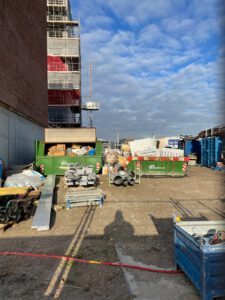
Construction logistics is increasingly recognised as a major blind spot in urban decarbonisation strategies. While attention has focused heavily on parcel delivery and retail freight, construction supply chains generate large freight flows, fragmented deliveries, and significant emissions in cities. This Emerald paper examines how supplier-led consolidation and integrated warehousing can reduce transport inefficiencies and embodied …

The economics of cargo bikes in city logistics: applications and business models

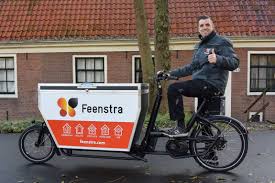
Growing pressure to decarbonise urban freight has intensified interest in cargo bikes as a low-emission alternative to conventional delivery vehicles. Grubmüller and colleagues provide a structured overview of how cargo bikes are currently used in logistics and of the emerging business models around them. Rather than focusing solely on environmental benefits, the paper examines the …

AI and LEFVs in City Logistics: Evidence from a Lisbon Last-Mile Case Study

The rapid growth of e-commerce has placed unprecedented pressure on last-mile logistics, now one of the most expensive and environmentally impactful segments of the supply chain. In response, Ferreira and Esperança (2025) investigate how integrating electric vehicles (EVs) and artificial intelligence (AI) can jointly transform urban delivery systems into more efficient, sustainable operations. Their study …

Amsterdam’s Circular Economy: A Spatial and Logistics Wake-Up Call

The Amsterdam metropolitan region faces a major spatial challenge. New housing, the energy transition, green infrastructure, and economic activity are all competing for scarce urban land. At the same time, the city aims to become fully circular by 2050. That immediately raises spatial questions: which circular functions are needed, how much space each requires, and …

Institutional barriers to dynamic truck charging: why electric road systems struggle in Europe

Electric Road Systems (ERS) – allowing trucks to charge while driving via overhead lines, inductive systems, or rail – are often presented as a promising solution for one of the main bottlenecks in heavy-duty electrification: large battery packs, long charging downtimes, and limited range. In theory, ERS could accelerate the shift to clean regional and …