Category «Research»

Dynamic Freight Management: A New Path for Sustainable Urban Logistics

Sustainable management of urban logistics (UL) is becoming increasingly urgent as cities grapple with rising congestion, worsening air quality, and growing e-commerce demand. Traditional freight management models—largely static and inflexible—struggle to cope with dynamic urban environments. A new study by Galkin, Švadlenka, Vrba, and Kijewska (2025) proposes a Dynamic Freight Management (DFM) framework that uses …

Review of A Spatial-Temporal Analysis of Logistics Vehicles

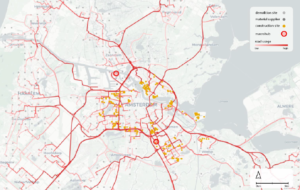
A recent thesis addresses one of the most pressing challenges in contemporary urban planning: how to reconcile the growing intensity of urban logistics activities with broader sustainability and livability goals. It adopts a spatial-temporal perspective on logistics operations, combining spatial analytics, machine learning, and case studies from Dutch cities. Conceptual framing The thesis rightly identifies …

Smarter Kerbside Management Shows Strong Results for London’s High Streets

A new report from London’s Cross River Partnership (CRP) highlights how digital kerbside management can transform freight operations and urban air quality. In collaboration with Grid Smarter Cities, CRP piloted a network of eight Virtual Loading Bays (VLBs) across London. Kerbside Management Technology Kerbside Management Technology is designed to dynamically manage urban kerb space, helping …

Behavior-Based Pricing Meets Promised Delivery Times: What Firms and Policymakers Should Know

The rapid growth of information technology enables firms to track consumer purchase histories. This allows them to distinguish between new and returning customers, and to adjust both prices and delivery promises accordingly. A recent study develops a two-period duopoly game-theoretic model to examine how these strategies (behavior-based pricing (BBP) and behavior-based promised delivery times (BBT)) …

Experimentation, Learning, and Organizational Change in City Logistics: Lessons from Bergen and Groningen

Cities increasingly use experimentation to tackle complex sustainability challenges. Experimentation allows actors to test new interventions in real-world contexts, creating opportunities for learning-by-doing. Yet, whether this learning translates into actual organizational change remains unclear. Recent research examines this relationship through four city logistics experiments in Bergen (Norway) and Groningen (Netherlands), offering insights into the dynamics …

Machine learning for time slot management in grocery delivery

The rise of online shopping has changed consumer expectations, with more people choosing to have products delivered directly to their homes. Grocery home delivery is a growing segment within this trend, but it presents specific logistical challenges. Groceries typically have low profit margins, while last-mile delivery is expensive. Orders are often large, heavy, and perishable, …

Optimizing Courier Efficiency in Last-Mile Delivery: Lessons from Real-World Data

The last mile is one of the most critical and costly segments in logistics. It directly shapes both operational efficiency and profitability. Yet, managing courier workflows remains complex due to varying work patterns, route deviations, traffic congestion, and other external factors. A recent study based on real-world data from a Spanish logistics company sheds light …

How Food Delivery Disrupts Urban Mobility: Insights from a Decade of Research

Food delivery services have more than tripled in size since 2017, accelerated mainly by the COVID-19 pandemic. This explosive growth has not only reshaped consumption habits but also had profound implications for urban mobility and last-mile logistics. A systematic literature review conducted between 2012 and 2022 offers the first comprehensive overview of how food delivery …

Success factors for scaling urban circular businesses in the food sector

As cities worldwide strive to transition to more sustainable food systems, small and niche circular food businesses are increasingly recognized as innovation leaders. However, scaling such initiatives beyond the experimental phase remains a significant challenge. A recent study based on eleven circular food ventures in Toronto, Canada, provides critical insights into what helps or hinders these …