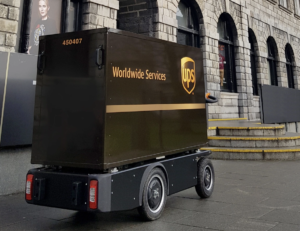
New electric vehicle for Dutch food service supplier Sligro

Dutch Sligro Food Group (food service) started the operational test of this unique vehicle that has been specially developed for sustainable and efficient urban distribution. The design is not based on an existing electric van or truck, but rather the other way around. Based on a vision for the future of urban distribution and functional …

Research: multi-objective approach for optimizing city logistics considering energy efficiency

The urban population increase results in more supply chain operations in these areas, which leads to increased energy consumption and environmental problems. In a new paper, about a multi-objective approach for optimizing city logistics considering energy efficiency the authors describe an optimization model of a multi-echelon collection and distribution system, focusing on downtown areas and …

How are consumers using collection points? Evidence from Brussels

Environmental assessments of e-commerce often focus on the last mile. Collection points are considered more beneficial than home delivery but this largely depends on how consumers’ collection trips are organized. Because this information is lacking, our objective is to find out how consumers make use of and travel to collection points by means of a …

Shaping urban freight systems via a participatory approach to inform policy-making

In the upcoming era of new technologies, a transport system is expected to be ‘more sustainable,’ ‘safer,’ and ‘more efficient.’ However, to what extent is this true? Based on the results of a series of stakeholder engagement workshops, a paper by Paddeu Daniela and Paulus Teguh Aditjandra explores the vision of different stakeholders about urban freight of the future.

LEAD – Low-Emission Adaptive last mile logistics through digital twins

The LEAD project will create Digital Twins of urban freight networks in six cities in TEN-T urban Nodes, namely Madrid (Spain), The Hague (the Netherlands), Budapest (Hungary), Lyon (France), Oslo (Norway), and Porto (Portugal). These will test and represent different innovative solutions for city logistics to address the requirements of the on-demand economy while aligning competing interests …

Designing a construction logistics control tower for city development

Construction logistics account for 35% of urban freight traffic and emissions in cities. With the growth in construction projects and the plans to reduce greenhouse gas emissions, better coordination of construction logistics for city development is necessary. TUDelft student Tom Tesselaar wrote his thesis about designing a construction logistics control tower for city development.