Optimizing the changing locations of mobile parcel lockers
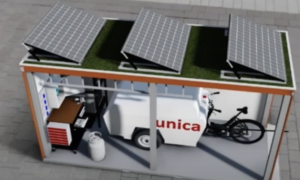
To reduce congestion, environmental damage, and negative health impact in large urban areas plenty of novel concepts for last-mile distribution have been innovated in recent years. The concept treated in this paper is mobile parcel lockers that are able to change their locations during the day, either autonomously or moved by a human driver.
Massive ramp-up of truck charging and re-fuelling infrastructure needed in Europe
The European Automobile Manufacturers’ Association (ACEA) has released new data on the number of charging points and re-fuelling stations required for zero- and low-emission trucks to meet the 2025 and 2030 CO2 targets. In terms of charging points for electric trucks, this means going from close to zero today to some 90,000 public points over …
Dutch experts on charging for the logistics sector
By 2030, in the Netherlands, all new cars must be zero-emission. The logistics sector will also switch from fossil fuels to electric power. This transition will only be possible if policies are made now and implemented to create a charging infrastructure that works well for the sector. How are the plans progressing and what are …
ICCT: European trucks are better designed than US trucks to control NOx emissions
There is a significant gap between real-world and certified NOx emissions from heavy-duty diesel vehicles. This gap is especially wide during urban driving conditions and other low-load operations in diesel HDVs certified under the US EPA 2010 program. A new ICCT-report compares NOx emission values from 11 HDVs designed to meet the EPA 2010 NOx …
The data gap: what we still don’t know about urban freight
Urban freight makes up an increasing percentage of transport operations and emissions, but there is no common methodology to capture the data we need to optimize deliveries for sustainable cities. Urban freight operations are run by a complex network of private and public sector actors. Often, the most comprehensive data available lies with the private sector, …
Is online grocery shopping better for the planet?
Amazon CEO Jeff Bezos claims grocery delivery cuts carbon emissions by 43% compared to traditional shopping. Grist did a fact-check. Grist spoke with experts. They said that on average, ordering online often reduces the carbon footprint of grocery shopping. The word average is key. This finding doesn’t scale down to the individual level neatly, and the way …
Construction logistics in cities: the case of building hospitals
When hospitals are built or renovated, they are often operational. To reduce disturbances and improve logistics performance, construction logistics solutions (CLS) can be deployed. Today, there is no best practice regarding CLS organizing. The purpose of a study by Linköping University and Aalto University was to explore how CLS’s can be classified in order to improve …
The role of Business Improvement Districts in sustainable urban freight
A paper by Brettmo and Browne explores the ways in which Business Improvement Districts (BIDs) can promote initiatives that lead to more sustainable urban goods movements in urban areas. They studied eight BIDs in three cities and in the UK, US, and Sweden. All the BIDs studied had considered or taken actions related to urban …
Amsterdam City Doughnut: moving towards a circular city
The Amsterdam City Doughnut takes the global concept of the Doughnut, developed by Kate Raworth, and turns it into a tool for transformative action in the city of Amsterdam. It marks the first presentation of the holistic approach to ‘downscaling the Doughnut’, combining local aspiration with global responsibility. How can our city be a thriving home to …