
Every city depends on goods to function, yet urban planning scholarship pays them little attention. That is the sobering conclusion of a systematic review by Heleen Buldeo Rai (VUB), Bram Kin (HAN), and Paul Buijs (University of Groningen), published in Cities (2026) and developed within the SPRONG LILS collaboration.
The authors reviewed 82 articles from ten leading urban planning journals, focusing on retail, housing, and food services; the “large freight generators” that produce and attract the most freight trips in any city. To test whether planners recognize freight implications even when not framed in logistics terms, they deliberately excluded words like “freight” and “logistics” from their search. The result: only a quarter of the articles mention freight at all, and most only indirectly. The spatial and temporal dimensions of moving, storing, and handling goods are rarely treated as explicit objects of urban governance.
Three patterns stand out. First, planning research is overwhelmingly spatial (why businesses locate and cluster where they do) while the temporal rhythms that structure freight operations (delivery schedules, peak hours, opening times) are largely ignored. Second, there is a persistent divide between planning and markets: where planning stays silent on freight, market dynamics fill the void. Third, even studies on sustainability and resilience, where freight is highly relevant, rarely extend their analysis to logistics.
The consequences of this blind spot are tangible. Freight facilities get displaced to peripheral areas, extending travel distances. Operations spill excessively into streets and curbs, intensifying congestion and conflicts. And environmental externalities concentrate in specific, often vulnerable, communities. Tellingly, one reviewed article claimed distribution centers “attract little planning opposition,” a statement few freight researchers would recognize: community resistance to urban warehouses is among the sector’s biggest challenges, from London to Paris to New York.
The authors translate their diagnosis into a planner-facing agenda organized along two axes (spatial-temporal and market-planning), with four recommendations: monitor the diversification and multiplication of freight generators and safeguard suitable sites close to demand; map freight rhythms at hotspots and provide basic facilities for freight workers; reserve sites for freight in urban plans and building codes; and codify time-sharing and access rules for streets and sites, calibrated to context. Paris’s “location perimeters,” which require developers to integrate freight activities into redevelopments, illustrate what this can look like in practice.
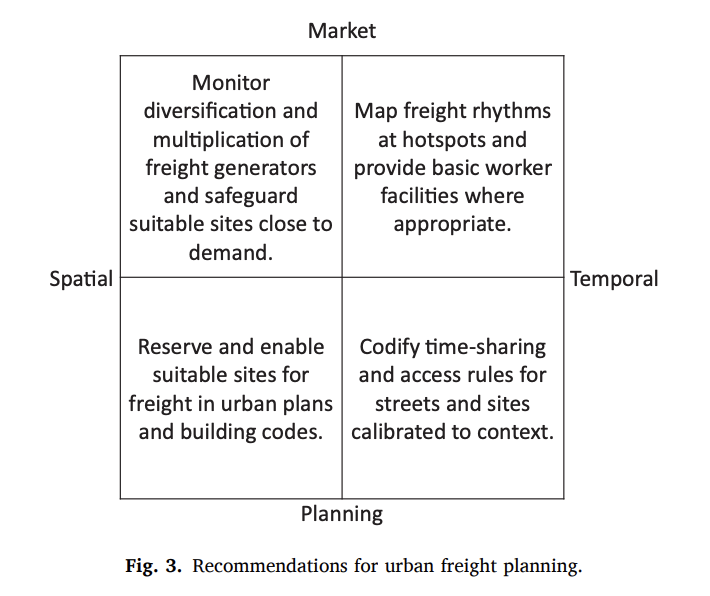
The core message resonates strongly with the debate: planning should anticipate freight demand rather than merely accommodate it. This applies especially to new residential neighborhoods and densification projects where the absence of space for goods and services undermines precisely the urban qualities planners seek to create. Homes, after all, may soon be the largest freight generators of all.
Also read: The 15-minute city needs 15-minute logistics. And that starts with innovating processes, not vans