
Urban logistics is in crisis. As city populations grow and e-commerce expands, the volume of goods moving through urban areas has risen sharply, leading to congestion, pollution, escalating delivery costs, and a diminished quality of life for residents. Logistics service providers (LSPs) are under mounting pressure to deliver goods faster and more cheaply, while municipalities increasingly impose restrictions to protect urban liveability. The tension between these competing demands defines one of the central challenges of twenty-first-century city planning.
A newly defended dissertation from Eindhoven University of Technology, by Abdo Abouelrous, takes a rigorous and timely look at how data and artificial intelligence can help resolve this tension. The thesis, titled Data-Driven Optimization for City Logistics, presents a cohesive research program centered on four interrelated contributions, each addressing a distinct dimension of decision-making in urban supply chains.
The Core Problem
City logistics involves two fundamental planning problems: order fulfillment (deciding which warehouse should supply which customer) and vehicle routing (determining the most efficient delivery sequence. Both problems are computationally NP-hard, meaning the number of possible solutions grows exponentially with scale. In practice, LSPs may serve hundreds or thousands of customers daily, rendering purely manual or rule-of-thumb approaches inadequate. Add to this the uncertainty inherent in urban environments (variable travel times, unpredictable demand) and the need to balance multiple, often conflicting, objectives (cost, emissions, working hours), and the planning challenge becomes formidable.
Smarter Inventory Planning Under Uncertainty
For order fulfillment in omnichannel retail settings, the thesis proposes a two-stage stochastic programming approach. Rather than planning for a single anticipated scenario, the method clusters historical demand data into representative scenarios and uses these to pre-optimize inventory levels before demand is realized. Compared to conventional mathematical approximations, this approach reduces total costs by up to 11.81%; a meaningful gain for any retailer operating at an urban scale.
Reinforcement Learning for Route Planning
To tackle the computational bottleneck of large-scale vehicle routing, the research applies reinforcement learning (RL) combined with a mathematical technique known as column generation. The RL model learns to construct efficient routes by interacting with a simulated environment and refining its decisions over many training episodes. The result is striking: the proposed method reduces travel time by more than 10% while solving large routing instances up to 35 times faster than a state-of-the-art dynamic programming benchmark. This speed advantage is critical in real-world operations, where routes often need to be planned or adjusted within tight time windows.
Multi-Objective Routing Under Uncertainty
Real-world logistics rarely involves a single objective. LSPs must simultaneously consider delivery cost, vehicle capacity utilization, fuel consumption, and driver working time. The third contribution extends the RL framework to handle multiple conflicting objectives alongside stochastic travel times. The resulting model produces solution sets (known as Pareto fronts) that outperform existing methods by an average improvement in hypervolume of over 8%, while maintaining feasibility in at least 65% of cases, even under conditions more variable than those encountered during training.
Digital Twins for Urban Logistics
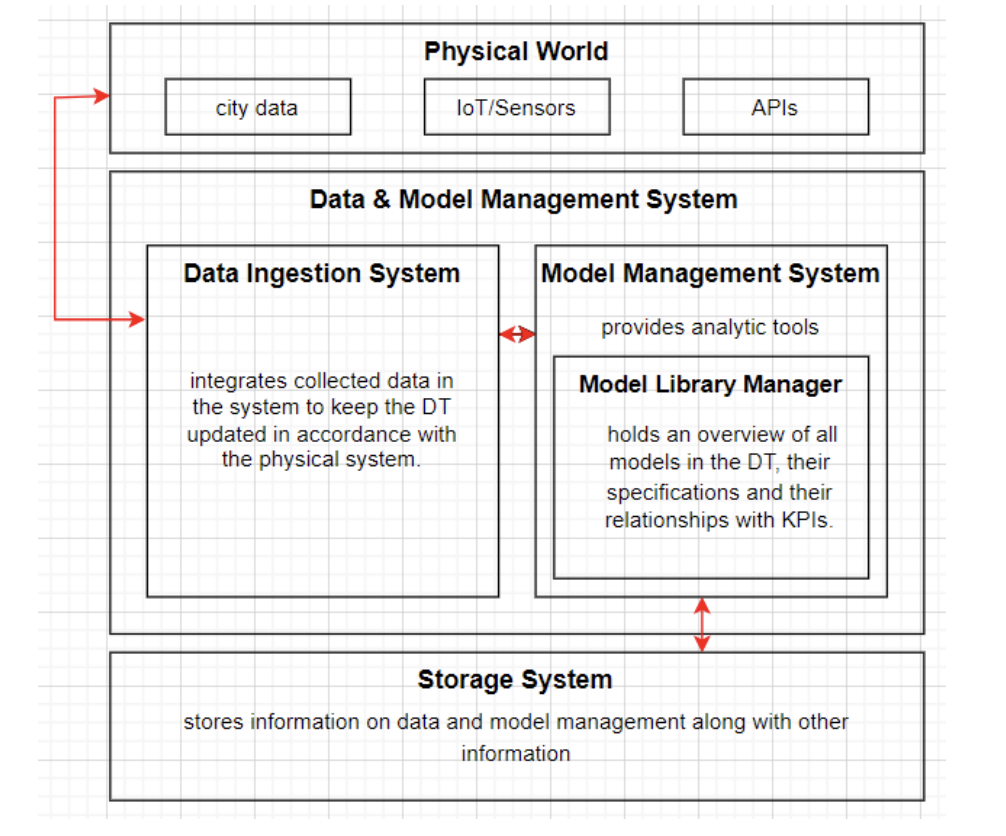
The final, and perhaps most integrative, contribution proposes a conceptual framework for Urban Logistics Digital Twins; virtual replicas of real-world logistics networks that are continuously updated with operational data. Unlike manufacturing-oriented digital twin designs, which assume closed, controllable environments, the proposed framework explicitly accounts for the open, unpredictable nature of cities. It defines the technical architecture, key functionalities, and practical setup methodology for a logistics-specific digital twin, and demonstrates how the earlier data-driven methods can be embedded within it.
Why This Matters
Abouelrous’s dissertation is a carefully constructed bridge between academic optimization research and the operational realities of city logistics. Its significance lies not only in the individual methodological advances but also in the coherent architecture it proposes for deploying AI in urban supply chains, from data collection through model training to real-time decision support. As cities worldwide grapple with the environmental and social costs of urban freight, frameworks like this offer a credible roadmap for making logistics smarter, leaner, and more compatible with sustainable urban life.
A summary of: Abouelrous, A.G.M. (2026). Data-Driven Optimization for City Logistics. PhD Thesis, Eindhoven University of Technology.