Category «Research»

Walking the Last 50 Feet: A Key to Smarter Urban Deliveries

In city logistics, delivery vehicles may get all the attention, but it’s what happens after the driver parks that truly defines last-mile success. A new empirical study in Seattle (USA) reveals the hidden but vital role of walking in delivery operations. It turns out that drivers spend most of their time outside the vehicle, navigating …

Assessing the sustainability of last-mile distribution strategies to manage expedited shipping

As e-retailers increasingly compete by offering consumer-centric services such as expedited deliveries, urban freight systems face mounting pressure to adopt sustainable last-mile distribution practices. While existing research has explored the performance of various distribution strategies under static planning and network design scenarios, their effectiveness under the dynamic and stochastic conditions characteristic of modern e-commerce remains …

Rethinking Urban Freight Governance: Four Roles for Public Authorities

A recent study in Norway sheds light on the evolving role of urban authorities in freight governance, particularly in smaller cities. While local governments have a presence in freight-related decision-making, many perceive their influence as limited—either by narrow institutional mandates or by a reluctance to regulate freight activities more assertively. This uncertainty often leads to …

Freight Consolidation in Small Cities: A Framework for Policy Design and Urban Livability

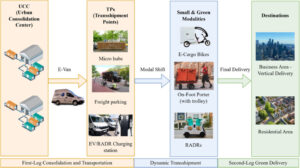
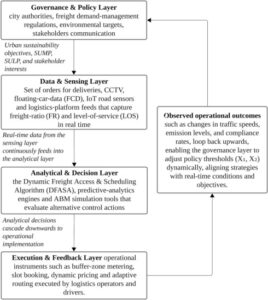
A recent academic study offers practical guidance for local authorities in smaller cities, helping them better understand and manage freight consolidation within their urban areas. Rather than prescribing specific regulatory measures—which are often subject to political change—the study introduces a structured framework that supports evidence-based policy development to improve urban livability. The approach is grounded …

CityFreight Workshop in Bergen (N): Sustainability in Urban Logistics – What Are Key Challenges & Future Research Agendas?

Last week, I attended the CityFreight Workshop in Bergen, Norway, “Sustainability in Urban Logistics – What Are Key Challenges & Future Research Agendas?” The event was excellently organized by the Center for Climate and Energy Transformation (CET) at the University of Bergen and the Center for Shipping and Logistics at the NHH Norwegian School of …

Smart Curbside Management: Flexible Parking for Efficient Last-Mile Delivery

Aligning parking policy with real-world driver behavior—through flexible sessions, smarter pricing, and optional reservations—can significantly improve curbside efficiency and reduce delivery friction. Urban planners and transport policymakers should consider these insights when modernizing curbside management to support sustainable and efficient last-mile delivery. Urban logistics professionals know all too well the challenges of finding parking for …

Why Sustainable Logistics in Norway Still Means ‘Clean’, Not ‘Less’

In Norway, sustainable logistics is shaped by two different and often conflicting narratives—those of public authorities and businesses. While both reference sustainability, they focus on various aspects of it. Public narratives show awareness of the three “grand narratives” of sustainable logistics: decarbonization, collective logistics, and the low-mobility society. However, public authorities mostly adopt a passive …

Shift to zero-emission heavy-duty vehicles is starting to gain some traction, but the transition is still in its early phase

Meeting Europe’s 2030 zero-emission targets for heavy-duty vehicles requires urgent action. While OEMs face binding CO₂ targets, demand-side incentives remain limited, hindering the adoption of operators. Instruments like ETS2, CO₂-based road charges, and subsidies are essential. Hydrogen vehicles, crucial for long-haul, face early-stage market challenges and infrastructure gaps. Infrastructure needs differ: urban fleets can use …

Smart Access: How Žilina Uses AI to Improve Its Pedestrian Zone

The historic city center of Žilina is taking smart steps to optimize the entry and movement of vehicles through its pedestrian zone. Using data-driven insights and intelligent technology, the city is working to regulate access more effectively, improve urban logistics, and make more efficient use of its limited public space. Researchers analyzed extensive data on …

As exhaust emissions decrease, non-exhaust emissions are now a dominant source of PM

Air pollution remains a persistent global issue, with particulate matter (PM) pollution posing significant health and environmental challenges, particularly in urban areas. As exhaust emissions decrease, non-exhaust emissions (NEEs) – particles from brake, tire, and road wear – are now a dominant source of urban particulate matter (PM). NEEs contribute to poor air quality and …