Category «Research»

AI and Co-Creation: Building Smarter Urban Logistics Alternatives

Urban areas are growing rapidly, and with them come familiar challenges: air and noise pollution, traffic congestion, parking shortages, and safety concerns. In this context, freight transport has become increasingly fragmented due to e-commerce, and as a result, it lacks coordination across supply chains. To address these challenges, a new study presents a co-creation-based decision …
Sustainable Neighborhood Logistics: Business Models for Urban Hubs

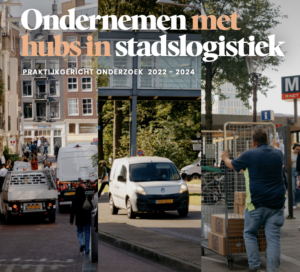
As cities grow denser and online shopping continues to rise, the demand for efficient logistics is increasing rapidly. Urban space is limited, and logistics hubs offer a promising solution: they consolidate goods and enable zero-emission transport into city centers. Some hubs also support shared mobility. To explore viable models, the Amsterdam University of Applied Sciences …

Creating Synergies Between Energy and Mobility

The energy and mobility sectors are increasingly interlinked, offering new opportunities for synergies in infrastructure use. However, the governance processes that underlie such cross-sectoral innovation are often overlooked. This case study examines the intricate decision-making process behind the development of an E-PT-hub. This initiative, undertaken by a Dutch public transport operator, aims to repurpose its metro power …

Urbanization and the Imperative of Public Space: A Global Perspective

Many cities around the world are missing out on significant development opportunities by ignoring, underutilizing, or mismanaging their public-space assets. Yet there is enormous potential to use these spaces more strategically and to unlock the hidden value they generate for communities, neighborhoods, and cities as a whole. The World Bank’s report, The Hidden Wealth of …

Crowdshipping in E-Grocery: A Smart Solution for Urban Last-Mile Logistics?

As cities face the dual challenge of growing e-commerce and the need for more sustainable urban mobility, improving last-mile delivery becomes essential, especially in the fast-growing sector of online groceries. A recent study explores how crowdshipping, where in-store shoppers deliver groceries to other customers, can offer a promising alternative to traditional van-based delivery models. Integrating …

Rethinking City Logistics: Sustainable Consolidation in Industrial Areas

When discussing urban logistics, the focus often lies on parcel deliveries to consumers—a trend that the rise of e-commerce has amplified. Yet, cities are also home to industrial zones with manufacturers and producers who have very different logistics needs. These areas depend on the timely delivery of bulky, perishable, or production-critical goods. Despite their importance, …

Rethinking passenger-vehicle coordination in urban mobility

In the age of smart urban mobility and AI-driven ride-hailing platforms, it’s easy to assume that more technology means better performance. But new research reveals a surprising insight: in some urban environments, old-fashioned, low-tech transport modes can outperform their high-tech counterparts—simply because they’re easier to coordinate. At the heart of this finding is a fresh …

Walking the Last 50 Feet: A Key to Smarter Urban Deliveries

In city logistics, delivery vehicles may get all the attention, but it’s what happens after the driver parks that truly defines last-mile success. A new empirical study in Seattle (USA) reveals the hidden but vital role of walking in delivery operations. It turns out that drivers spend most of their time outside the vehicle, navigating …

Assessing the sustainability of last-mile distribution strategies to manage expedited shipping

As e-retailers increasingly compete by offering consumer-centric services such as expedited deliveries, urban freight systems face mounting pressure to adopt sustainable last-mile distribution practices. While existing research has explored the performance of various distribution strategies under static planning and network design scenarios, their effectiveness under the dynamic and stochastic conditions characteristic of modern e-commerce remains …