Beyond Materials: The Critical Role of Logistics in Circular Building Systems

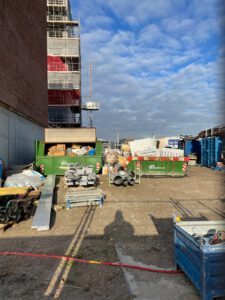
The recent study Logistics for Building Circular, Biobased, and Modular: Environmental Impacts in Amsterdam, published in the Journal of Circular Economy, examines the role of logistics in circular construction practices, with a specific focus on the urban context of Amsterdam. The article analyses how logistics systems influence the environmental performance of circular, biobased, and modular …

Antea Local Traffic Monitor: also for analysing urban logistics and construction traffic

Cities are constantly in motion. New housing developments, new and redesigned streets, and growing logistics flows all require innovative solutions to keep the city traffic-safe, liveable, and sustainable. The Local Traffic Monitor, developed by Antea Group together with the municipalities of Rotterdam and The Hague and the Topsector Logistics, offers precisely that: an objective instrument …

Decarbonising Heavy-Duty Road Transport: What Pathways Work and What It Means

Heavy-duty road transport is one of the most persistent sources of greenhouse gas emissions, and reducing its climate impact is essential to meeting global decarbonisation targets. In their review in Nature, Zhang and colleagues evaluate the feasibility, economic viability, and emissions reduction potential of key clean pathways: chiefly battery electric trucks (BETs), fuel cell electric …

City Logistics 4.0: Key Conclusions from a Systematic Review

The study by Corvello et al. (2025) provides the most comprehensive attempt to date to integrate the fragmented research landscape on City Logistics 4.0 (CL4.0). By analysing 194 peer-reviewed papers, the authors propose a new conceptualization of CL4.0, synthesize technological, logistical, and sustainability perspectives, and outline a robust future research agenda. Four overarching conclusions emerge. …

Physical Internet and the Future of City Logistics

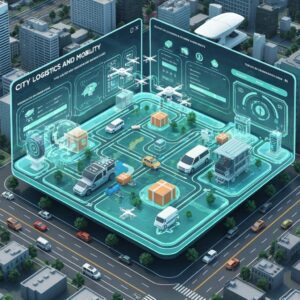
City logistics faces mounting pressure from congestion, emissions, rising delivery volumes, and scarce urban space. The Physical Internet (PI) offers a transformative framework to address these challenges by applying the principles of digital internet architecture to the movement of physical goods. Instead of closed, proprietary logistics networks, PI envisions an open, interoperable, and highly connected …