
Urban freight is messy, fast-moving, and politically contentious. Deliveries compete with pedestrians for space, logistics providers compete with each other for efficiency, and city planners are left trying to regulate a system they can barely see. Digital twins (virtual replicas of city systems that can simulate, predict, and advise) are increasingly being positioned as the tool that could change that. But what are they actually capable of, and how far have we really come?
A chapter in Urban Logistics Transformation (Springer, 2026) by Tavasszy and colleagues offers one of the clearest roadmaps yet for digital twins in city logistics. The authors are careful not to oversell the technology: they distinguish between a basic “digital shadow” (essentially a real-time mirror of what’s happening) and a fully autonomous digital twin that can actually trigger interventions in the physical world. Most of what exists today sits closer to the former.
What digital twins actually do
The authors frame digital twins as decision-support tools that operate across three timescales. At the operational level, they help manage daily delivery flows: rerouting vehicles, adjusting access restrictions, and monitoring congestion in real time. At the tactical level, they support weekly or monthly planning: fleet schedules, consolidation hub usage, and time-window management. At the strategic level, they inform longer-term infrastructure investment and regulatory design; the kind of decisions that play out over years.
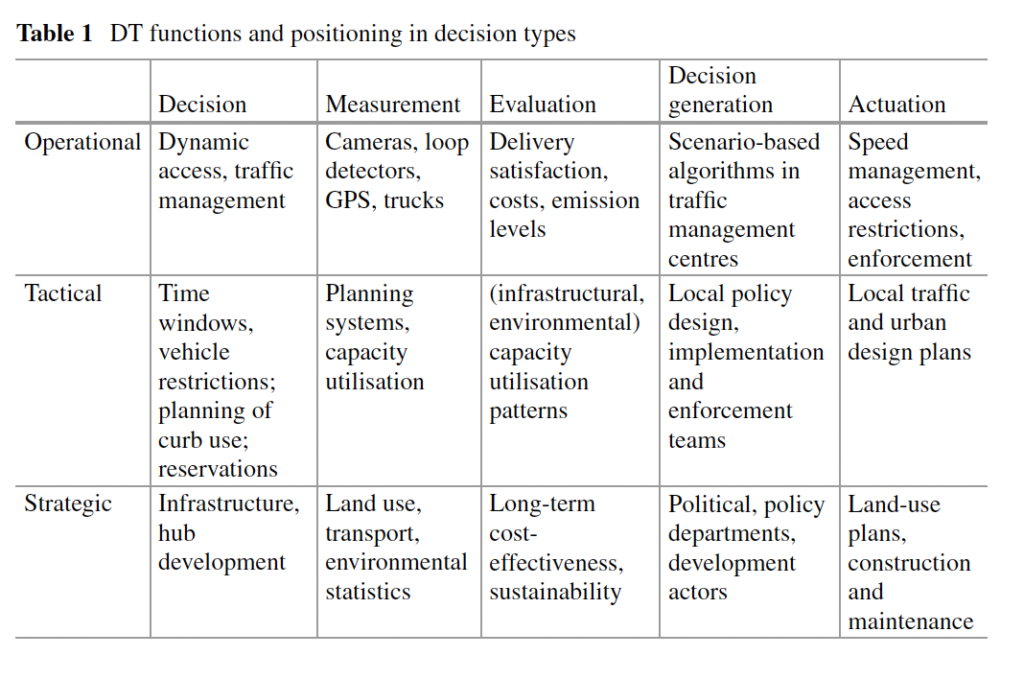
Each timescale requires different data, different models, and different stakeholders. That sounds obvious, but it’s a point that urban logistics practice has often ignored, treating digital tools as one-size-fits-all solutions when the underlying decision logic is fundamentally different at each level.
Two approaches, one ambition
The chapter focuses on three concrete digital twin implementations from recent EU projects (URBANE, LEAD, and a Dutch national initiative), which represent two contrasting architectural philosophies.
URBANE took a centralized approach: a single integrated simulation environment applied consistently across cities. At its core sits a coupling of two agent-based models — MASS-GT for logistics demand and vehicle routing, and HUMAT for modeling consumer behavior within social networks. Applied to a Helsinki living lab focused on autonomous delivery vehicles (ADVs), the system simulated 220 parcel deliveries over 31 days under varying capacity and arrival conditions. The finding that increasing ADV capacity alone does not significantly improve delivery rates — because time-window constraints are the real bottleneck — is the kind of insight that only emerges from simulation, not intuition.
LEAD took the opposite route: a distributed model library where different simulation components can be mixed and matched depending on the policy question at hand. This is more flexible, but also more demanding. It requires expert users who understand the assumptions embedded in each model, and risks internal inconsistency when components designed under different frameworks are combined. The authors are honest about this trade-off.
The governance gap
What runs through the chapter is the acknowledgment that technical sophistication alone does not make a digital twin useful. The authors repeatedly stress that closing the loop between sensing, modeling, decision-making, and implementation requires institutional alignment that the technology cannot create on its own.
Cities that want to use digital twins seriously need to invest in shared data infrastructure, cross-departmental coordination, and governance arrangements that connect model outputs to actual policy levers. Without that, even the most advanced simulation remains a sophisticated exercise in producing reports that nobody acts on.
Where this leaves us
Digital twins for city logistics are real, improving fast, and already producing policy-relevant insights. But they are not yet the autonomous urban management systems that the smart city discourse sometimes implies. The honest picture is one of digital shadows gradually learning to cast their influence forward. They are useful tools in the hands of informed institutions, not substitutes for them.
Also read:
Based on: Tavasszy et al., “Digital Twins for City Logistics: Towards a Roadmap,” in Urban Logistics Transformation (Springer, 2026). Tavasszy, L., Tapia, R., de Bok, M., Cebeci, M., Winkelmann, F.N., Gürcan, Ö. (2026). Digital Twins for City Logistics: Towards a Roadmap. In: Melkonyan-Gottschalk, A., Li, Y. (eds) Urban Logistics Transformation. Greening of Industry Networks Studies, vol 15. Springer, Cham. https://doi.org/10.1007/978-3-032-08387-6_6