
City authorities across Europe are under growing pressure to make urban logistics more sustainable. Zero-emission zones, last-mile delivery regulations, and climate targets are multiplying. Yet despite this political momentum, most cities continue to handle logistics in a fragmented, reactive way. Why is progress so slow?
A new study from the Norwegian Center for Transport Research (TØI) offers a refreshingly candid answer: it is not just a matter of political will or the right strategy document. The problem runs deeper into the daily work systems through which municipal staff are expected to understand and influence a complex, fast-moving logistics ecosystem.
The concept: cognitive misalignment
Researchers Phillips and Jensen apply a framework from cognitive systems engineering to interview 16 experienced practitioners across four major Norwegian city authorities. Their central argument is that municipal staff face cognitive misalignment: a mismatch between what their jobs demand and what their work systems actually support.
City officials are expected to anticipate how carriers will respond to a new access regulation, coordinate delivery policies across departments, evaluate the sustainability impact of parcel lockers, and keep pace with the rapid growth of e-commerce. But they are doing all of this with limited data, siloed responsibilities, blunt regulatory tools, and no stable structures for learning from practice.
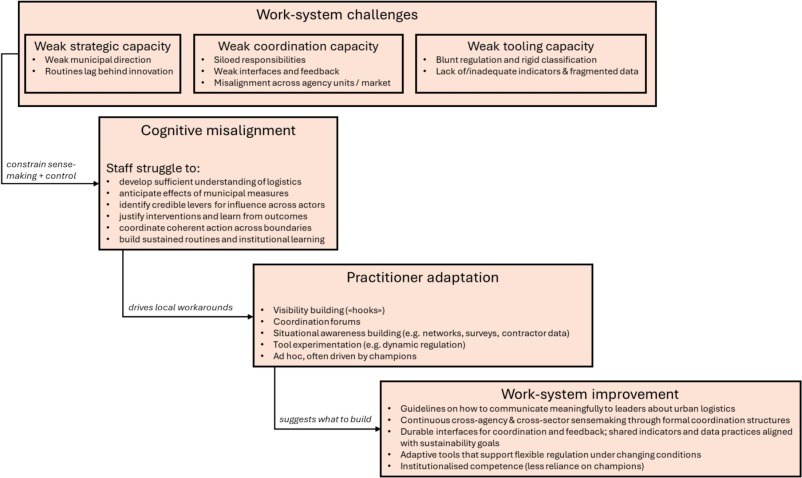
Three types of weakness
The study identifies three recurring categories of work-system weakness.
The first is weak strategic capacity. Urban logistics has long been treated as a commercial matter, leaving municipal departments without clear direction or shared priorities. Planning routines lag behind logistics innovation — inconsistent approval processes for parcel lockers, for instance, slowed their adoption rather than enabling it.
The second is weak coordination capacity. Within cities, departments pursue overlapping sustainability goals through uncoordinated measures. In one case, a city simultaneously invested in charging infrastructure to support electric delivery vehicles while restricting vehicle access in the same area — contradictory policies that canceled each other out. Across city boundaries, differences in how municipalities classify and regulate logistics make coherent corridor-level governance nearly impossible.
The third is weak tooling capacity. Static signs and rigid vehicle classifications are poorly matched to the realities of modern logistics. A cargo bike can use the pavement because it is classified as a bicycle; a small electric freight vehicle cannot, because it is classified as a car.
Meanwhile, meaningful sustainability metrics — measuring noise, energy use, equity impacts — are largely absent, making it hard for staff to demonstrate progress or justify new measures to decision-makers.
What practitioners actually do
Despite these constraints, the practitioners interviewed were far from passive. They built informal networks to access logistics expertise, created ad hoc coordination forums across departments, assembled situational awareness from whatever data they could find, and championed pilot projects to generate learning. Some developed creative “hooks” — simple, visual representations of logistics problems — to get the attention of political leaders.
These workarounds are valuable but fragile. Progress depends too heavily on individual champions. When those people move on, the knowledge and momentum often go with them.
The design implication
The authors argue that these informal adaptations point to what better-designed work systems should look like: durable coordination structures across agencies and municipalities, shared indicators aligned with real sustainability outcomes, flexible regulatory tools such as geofencing, and institutionalized logistics competence that does not rely on a handful of enthusiastic individuals.
The practical message for city logistics professionals is clear. Sustainable Urban Logistics Plans are necessary but not sufficient. What cities also need is investment in the operational infrastructure that enables staff to implement them day after day across departments, as the logistics landscape keeps changing.