
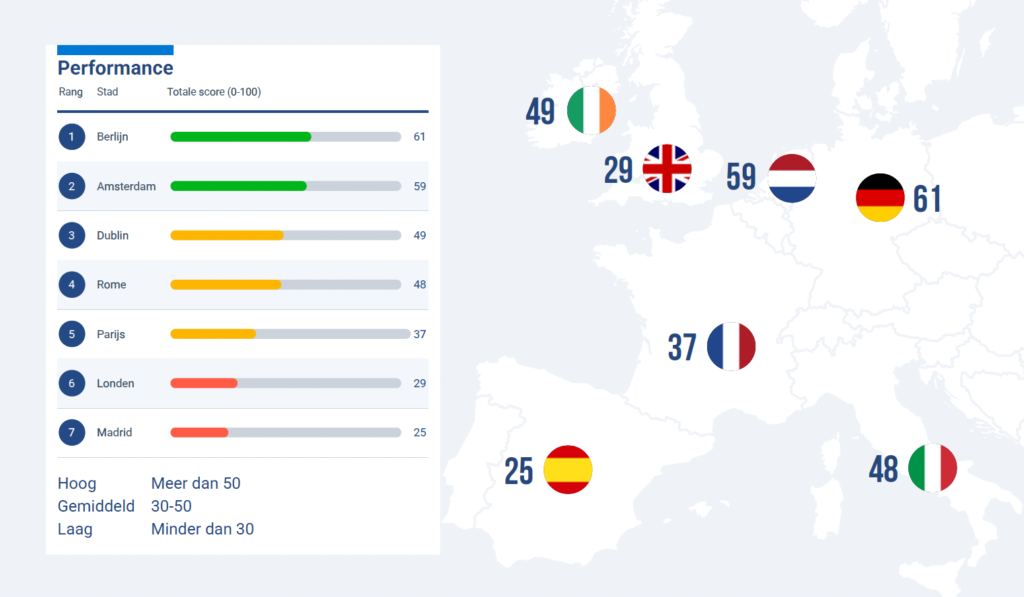
Amsterdam and Berlin are among the European frontrunners in efficient urban logistics. This is shown by the European Freight Efficiency Index from Geotab, which is based on connected-vehicle data from seven European capital cities. Amsterdam scores 59 out of 100 points, finishing just behind Berlin (61). London (29) and Madrid (25) bring up the rear.
The study is interesting because it looks beyond classic congestion figures. Not only does traffic pressure count, but also how predictable and free-flowing a city is for logistical operations. That is precisely where an important lesson lies for European cities.
A city is allowed to be slow
The dominant thinking in much urban policy is still that lower speeds equate to worse logistics. The Geotab data show something different: a city can be slow, as long as vehicles keep moving. Stop-start traffic causes far more operational damage than stable flow. Rome is the most striking example of this. The city experiences heavy congestion, yet scores surprisingly well on trip inefficiency because vehicles continuously keep moving rather than constantly coming to a standstill.
Amsterdam
Amsterdam scores highly thanks to a completely different model. Its compact urban structure, short trip distances, and optimized traffic lights allow vehicles to travel through the city relatively efficiently. The city even achieves one of the best scores for limiting waste from idling engines.
This is an important insight for urban logistics experts. The quality of logistical performance is determined not solely by capacity but, above all, by network behavior. A city with limited space can still function efficiently when traffic flows remain predictable, and vehicles do not constantly have to stop, accelerate, or take detours.
This connects the report directly to debates playing out in European cities. Many cities rely heavily on restrictions: zero-emission zones, time windows, road closures, car-free areas, and limitations on delivery and freight vehicles. These measures can contribute to liveability, but the Geotab analysis shows that fragmentation of traffic flows can also create a “structural burden” on logistics: extra buffer times, missed delivery windows, and higher operational costs.
Lessons for cities
The first lesson is that traffic management is becoming more important than pure infrastructure expansion. Smart traffic signals, prioritization of logistics routes, and predictable access systems deliver more value than simply adding extra road capacity. The researchers emphasize that high-scoring cities invest in distributed traffic flows, coordinated traffic lights, and freight-specific infrastructure.
The second lesson is that logistical efficiency is increasingly becoming a data challenge. Connected vehicle data makes it visible where structural bottlenecks arise. In Amsterdam, 13.7% of all driving events are concentrated around Schiphol Airport. According to Geotab, this does not point to a systemic flaw, but to a solvable infrastructure problem. For cities, this means traffic policy can be configured far more precisely when real-time vehicle data is integrated into urban mobility management.
The third lesson concerns the organization of urban logistics itself. Truck fleets perform better than passenger vehicle fleets in virtually all cities — not because of different technology, but through operational discipline: planned routes, delivery windows, trip structure, and professional planning. This once again confirms that urban logistics is not only an infrastructure issue, but also a matter of collaboration, planning, and professional management.
Sustainability
It is also noteworthy that Amsterdam demonstrates that sustainability and logistical efficiency need not conflict. Many discussions about zero-emission zones are conducted as though sustainability automatically leads to higher costs and lower efficiency. This index instead suggests that well-designed urban networks can combine both goals: lower emissions and better logistical performance.
For European cities, this presents an important challenge. The report warns that urban freight flows are outpacing available road capacity. At the same time, restrictions on fossil-fuel vehicles continue to increase. This means cities can no longer think only about reducing traffic but must focus, above all, on better-organized traffic.
Amsterdam proves that compact, busy cities need not grind to a logistical halt. But that requires continuous attention to traffic flow, predictability, and data-driven traffic management. The real challenge for European cities is therefore not to reduce logistics, but to organize them intelligently.
Walther Ploos van Amstel