Tag «city logistics»

The economics of cargo bikes in city logistics: applications and business models
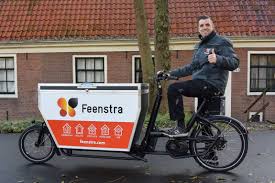
Growing pressure to decarbonise urban freight has intensified interest in cargo bikes as a low-emission alternative to conventional delivery vehicles. Grubmüller and colleagues provide a structured overview of how cargo bikes are currently used in logistics and of the emerging business models around them. Rather than focusing solely on environmental benefits, the paper examines the …
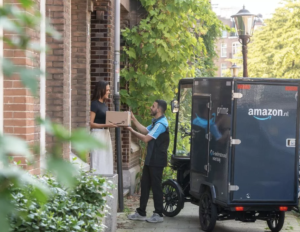

AI and LEFVs in City Logistics: Evidence from a Lisbon Last-Mile Case Study

The rapid growth of e-commerce has placed unprecedented pressure on last-mile logistics, now one of the most expensive and environmentally impactful segments of the supply chain. In response, Ferreira and Esperança (2025) investigate how integrating electric vehicles (EVs) and artificial intelligence (AI) can jointly transform urban delivery systems into more efficient, sustainable operations. Their study …

What is the value of urban logistics by water?

Amsterdam maps the business case for waterborne urban logistics: it is not automatically a ‘no-regret’ option. The City of Amsterdam has been exploring for several years whether water transport can play a larger role in urban logistics. A recent exploratory cost–benefit analysis compared the societal and financial impacts of waterborne transport with road transport and …

Amsterdam’s Circular Economy: A Spatial and Logistics Wake-Up Call

The Amsterdam metropolitan region faces a major spatial challenge. New housing, the energy transition, green infrastructure, and economic activity are all competing for scarce urban land. At the same time, the city aims to become fully circular by 2050. That immediately raises spatial questions: which circular functions are needed, how much space each requires, and …

Key takeaways from POLIS – ALICE Webinar Series 2025: City Logistics in the Circular Economy

On 9 December 2025, ALICE and POLIS jointly organised the members-only webinar “From Movers to Enablers: the role of logistics in circular supply chains”. The session brought together logistics experts, researchers, and city representatives to explore how logistics service providers can move beyond traditional transport roles and become key enablers of circular economy models.  The webinar focused on the growing importance of reverse logistics in enabling reuse, repair, …

The Shift to Software-Defined Vehicles: Implications for City Logistics

McKinsey’s recent analysis of the automotive software and electronics landscape shows that the global automotive sector is undergoing a profound structural shift. Vehicles are rapidly evolving from primarily mechanical products into software-driven platforms. While the traditional automotive market grows at only around 1 percent annually, software and electronics are projected to grow by more than …

Beyond Materials: The Critical Role of Logistics in Circular Building Systems

The recent study Logistics for Building Circular, Biobased, and Modular: Environmental Impacts in Amsterdam, published in the Journal of Circular Economy, examines the role of logistics in circular construction practices, with a specific focus on the urban context of Amsterdam. The article analyses how logistics systems influence the environmental performance of circular, biobased, and modular …

Antea Local Traffic Monitor: also for analysing urban logistics and construction traffic

Cities are constantly in motion. New housing developments, new and redesigned streets, and growing logistics flows all require innovative solutions to keep the city traffic-safe, liveable, and sustainable. The Local Traffic Monitor, developed by Antea Group together with the municipalities of Rotterdam and The Hague and the Topsector Logistics, offers precisely that: an objective instrument …

➤