Tag «city logistics»

City Logistics 4.0: Key Conclusions from a Systematic Review

The study by Corvello et al. (2025) provides the most comprehensive attempt to date to integrate the fragmented research landscape on City Logistics 4.0 (CL4.0). By analysing 194 peer-reviewed papers, the authors propose a new conceptualization of CL4.0, synthesize technological, logistical, and sustainability perspectives, and outline a robust future research agenda. Four overarching conclusions emerge. …

Physical Internet and the Future of City Logistics

City logistics faces mounting pressure from congestion, emissions, rising delivery volumes, and scarce urban space. The Physical Internet (PI) offers a transformative framework to address these challenges by applying the principles of digital internet architecture to the movement of physical goods. Instead of closed, proprietary logistics networks, PI envisions an open, interoperable, and highly connected …

Geopost launches Geopost Vision, a new venture serving the future of mapping and mobility

Urban logistics is getting a digital upgrade. Geopost, Europe’s leading parcel delivery network, has launched Geopost Vision. This is a groundbreaking initiative that transforms its 65,000-vehicle fleet into a continent-wide street-level imaging platform. Turning Deliveries into Data Every day, Geopost’s delivery vans traverse over 2 billion kilometers annually across 22 European countries. Rather than letting …

ACEA Europe’s vans are falling behind. And that directly impacts city logistics

The electrification of light commercial vehicles (LCVs) is progressing far too slowly to meet Europe’s climate targets. That’s not just a policy issue—it’s something cities experience on the ground every day. Despite growing manufacturer investment and an expanding range of electric models, real-world adoption is lagging. ACEA’s new position paper makes it clear: at the …

Quiet, emission-free deliveries on Hamburg’s waterways

Can city deliveries be made quietly, emission-free, and stress-free? Hamburg is testing exactly that. As part of the InnoWaTr project’s Freight Flow Coalition No. 3, the city launched its first pilot runs using fully electric boats on the Alster lake and canals. The pilot was carried out by Logistics Initiative Hamburg and TOP Mehrwert-Logistik, in …

Federated learning and collaborative AI: step-by-step

Federated learning (FL) and collaborative AI (CAI) offer new ways to make city logistics more efficient, sustainable, and resilient while protecting sensitive data. In traditional logistics, sharing operational data between companies or with cities is often difficult due to competition and privacy concerns. FL solves this by allowing each company to train AI models locally …

City Logistics: Moving Forward Together

Delivering goods safely and cleanly – and collecting waste efficiently – in our city centers is a significant challenge. This is especially true since the introduction of zero-emission zones on January 1, 2025, while urban populations continue to grow. The Netherlands Environmental Assessment Agency (PBL) predicts that by 2035, the four largest cities will experience …

Review of A Spatial-Temporal Analysis of Logistics Vehicles

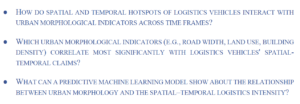
A recent thesis addresses one of the most pressing challenges in contemporary urban planning: how to reconcile the growing intensity of urban logistics activities with broader sustainability and livability goals. It adopts a spatial-temporal perspective on logistics operations, combining spatial analytics, machine learning, and case studies from Dutch cities. Conceptual framing The thesis rightly identifies …

Experimentation, Learning, and Organizational Change in City Logistics: Lessons from Bergen and Groningen

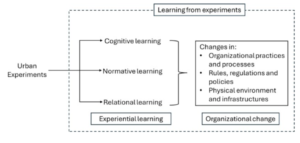
Cities increasingly use experimentation to tackle complex sustainability challenges. Experimentation allows actors to test new interventions in real-world contexts, creating opportunities for learning-by-doing. Yet, whether this learning translates into actual organizational change remains unclear. Recent research examines this relationship through four city logistics experiments in Bergen (Norway) and Groningen (Netherlands), offering insights into the dynamics …

➤