
PostNL’s first-quarter 2026 figures are a wake-up call for everyone in e-commerce. Parcel volumes fell 7.1%. This is the new reality. The party is over. The years of double-digit e-commerce growth are behind us for the most part — yet the sector is still deep in denial.
Five years have passed since the Covid boom of 2020 and 2021, when growth sometimes hit 25% a year. The market is now mature, saturated, and brutally competitive. The expectation that growth will simply return on its own is a dangerous illusion. It is time to face the numbers and make hard choices.
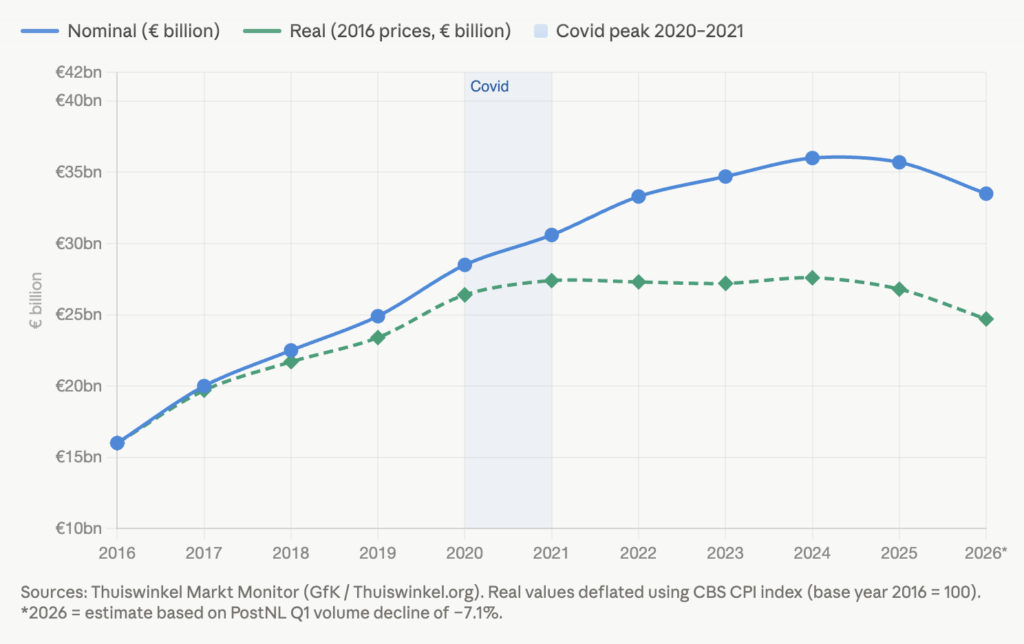
PostNL’s volume decline is coming from two directions. Domestic volumes fell 5.5%, driven by lower consumer spending and geopolitical uncertainty. Dutch consumers are buying less online — and anyone who cannot see that in their own figures is not looking hard enough. On top of that, international volumes from Asian webshops fell by up to 13.2%, partly due to PostNL’s deliberate contract negotiations. The cheap volume flow from China is drying up. That affects everyone in the chain, including online retailers.
The parcel market is facing a fundamental reset. Too much capacity, too little margin, and a relentless price war. The result is a race to the bottom in which service quality and working conditions are the first casualties. Online retailers are contributing to this themselves by systematically choosing the cheapest delivery option. Understandable from a cost perspective — but no longer sustainable in a market without automatic growth. Has the consumer completely dropped off the radar?
The Coalition of Change, an initiative of Thuiswinkel.org, points the way forward: shift from always-as-fast-as-possible to delivery at the moment that suits the consumer best. Data shows that only 20 to 25% of all orders are genuinely urgent. Giving consumers more control over delivery day and time window leads to more evenly distributed supply chain flows, better planning, and lower costs — for carriers and for online retailers alike. Some webshops are already doing this: 56% now offer consumers the option of later delivery. The rest are falling behind.
PostNL itself has already chosen value over volume. That strategic shift must also happen among online retailers. Stop treating the cheapest carrier as the automatic default. Invest in the best delivery experience — because consumers remember how their parcel arrived, not what it cost.
In a consolidated market without double-digit growth, you don’t win on price. You win on trust, loyalty, and repeat customers. The double-digit growth era is not coming back. But those who dare to invest in quality and innovation now will be playing in the European Champions League before long. The rest will be watching from the sidelines.
Walther Ploos van Amstel.